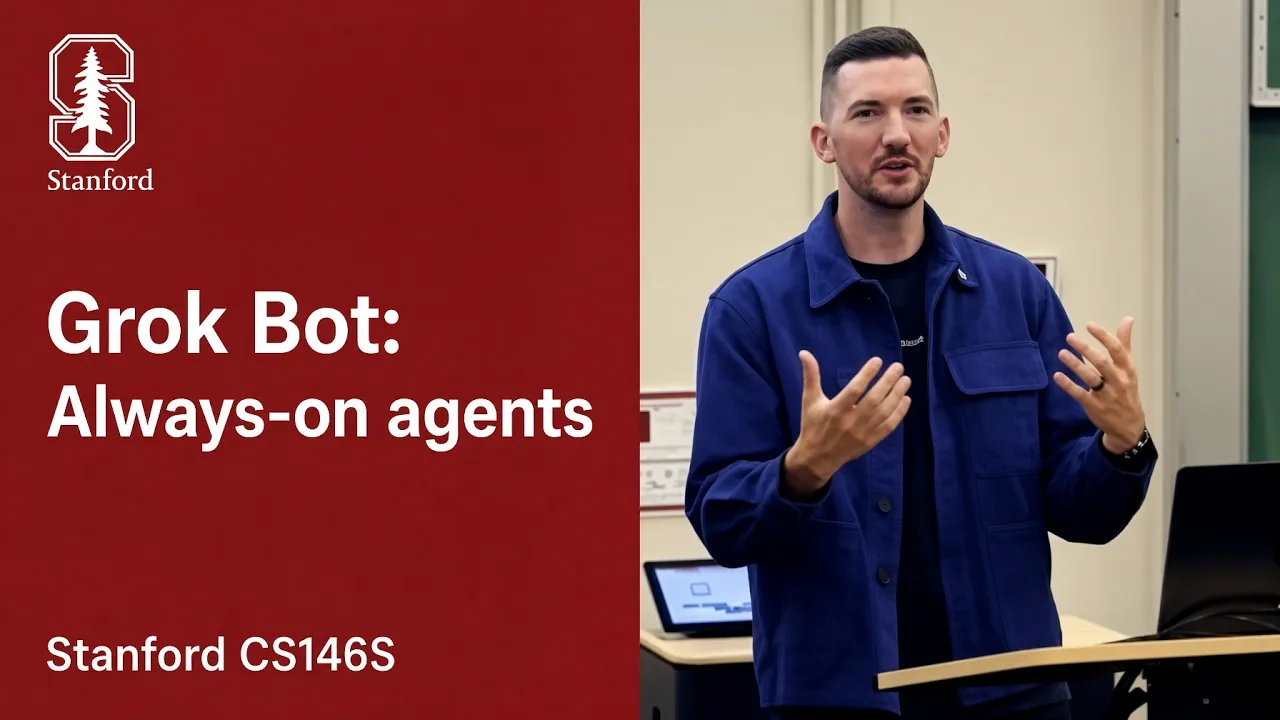
An educational lecture on turning a model-and-tools loop into a persistent, proactive agent. Lee explains the server and cloud-computer architecture, crash recovery, tool selection, context and memory management, and the evaluation loops used to improve the product. 2:08
Topics
- Introduction to always-on agents
- The evolution of AI development
- Model capabilities, files, and skills
- Architecture and agent lifecycle
- Server mechanics and durable execution
- Building the agent harness
- Context engineering and prompt caching
- Managing agent memory
- Training and product iteration
- Future outlook and open problems
Key takeaways
- Always-on agents can sleep between events. Persistence comes from saving state and restoring it when a message or background event wakes the agent.
10:0510:58 - Keep the agent loop on a server separate from its Linux VM so the computer can shut down or be rebuilt independently.
14:3015:04 - The implementation uses Temporal durable workflows to resume after infrastructure failures; helpers also run as durable workflows.
16:4217:0624:34 - Load tool details on demand, delegate verbose work to helpers, and return results to the main agent. This conserves its finite context window rather than creating literal infinite context.
20:4823:3024:07 - Stable prompt prefixes preserve cached tokens. Compacting a long conversation while its cache is still warm reduces the cost of summarization and later turns.
28:1332:0332:30 - Memory has different lifetimes: persistent user facts, dated activity logs, temporary scratchpad notes, and files retrieved when needed.
32:5133:3934:05 - Product improvement has two loops: turn failures into evaluations and ship verified fixes frequently, then use those failures and evaluations to improve later models.
36:1336:38