Train for the environment
- Pre-training builds general knowledge from internet text and other data.
34:29 - Supervised fine-tuning teaches assistant or agent behavior. Examples of the actual harness help the model learn its tools and environment.
34:2934:58 - Reinforcement learning can improve instruction following, skill selection among hundreds of skills, and browser interaction.
34:5835:25
Serve different roles differently
- Optimize the main conversational agent for low latency so it responds promptly to the user.
35:25 - Long-running helpers tolerate different tradeoffs. For a background task, Lee uses 10 versus 12 minutes as an example of a difference that may matter little to the user.
35:50
Two improvement loops
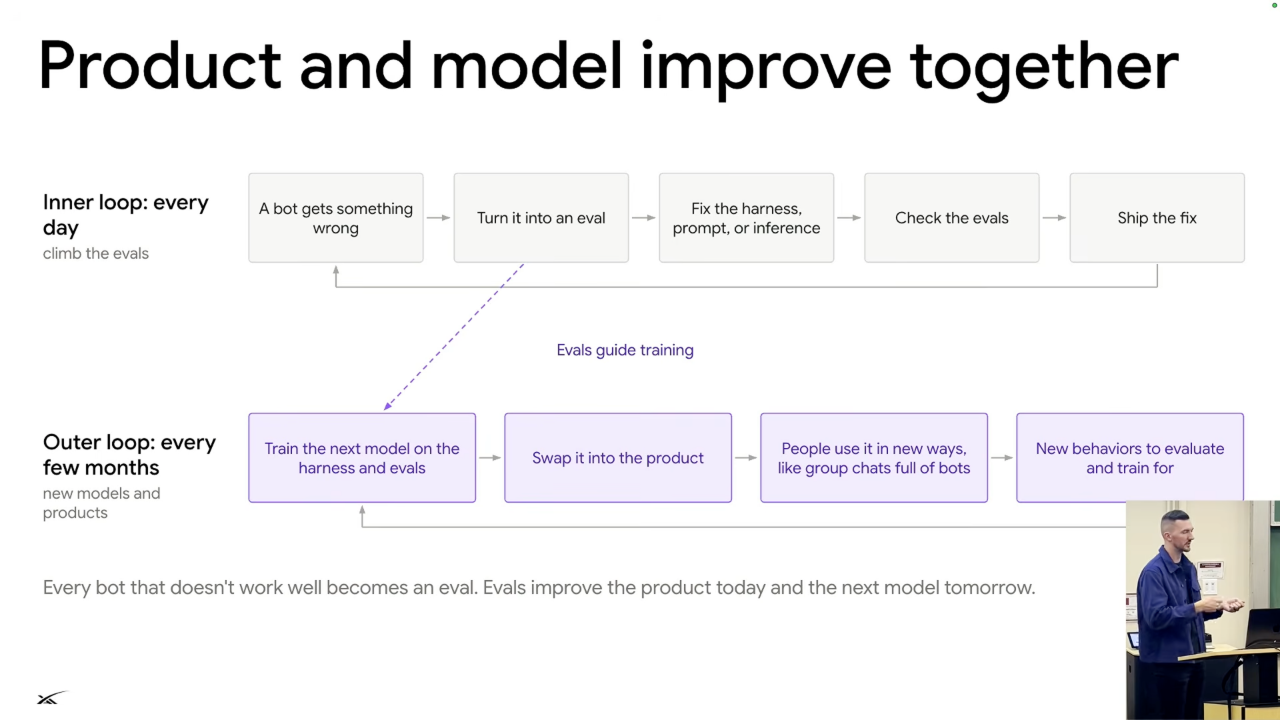
Figure 9. Failures become evaluations for daily product fixes and later model training. New model capabilities introduce new behaviors to evaluate. Source: leerob, 36:38.
- The inner loop runs frequently: capture a failure, make it an evaluation, fix the harness, prompt, code, or inference behavior, verify the fix against evaluations, and ship. An incorrect tool call is the example failure.
36:1336:38 - The outer loop trains new models over longer cycles, using failures and evaluations to improve the behaviors the product needs before substituting the model into the product.
36:38 - New capabilities expose new interaction problems. Lee identifies group chats and bot-to-bot communication as emerging use cases with limited training data that need explicit behavioral training.
37:0237:25