The Pragmatic Engineer podcast · 1:29:56 · Watch on YouTube
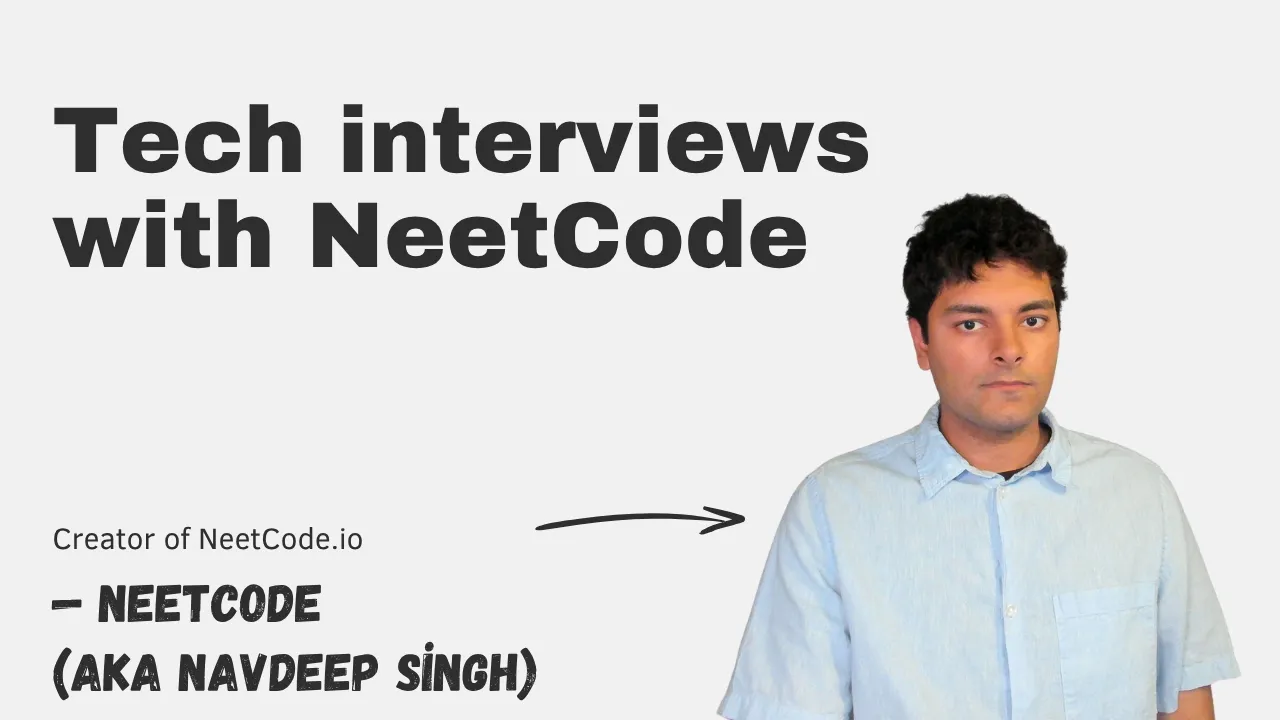
Gergely Orosz interviews Naveed "Navi" Singh, creator of NeetCode, the coding interview prep platform. The conversation is part career story (quitting Amazon after two months, a fast Google promotion, leaving to go all-in on NeetCode) and part engineering philosophy: why DSA interviews refuse to die, why deliberately not fixing a production bug can be the right call, what interview prep actually teaches, and a series of hot takes on AI skill erosion, hiring for agency over credentials, and why effort is becoming the scarce resource now that AI makes everything else cheap.
flowchart LR
    A[Career story] --> A1[Amazon: quit in 2 months]
    A1 --> A2[Google: promoted in 1 year]
    A2 --> A3[All-in on NeetCode]
    B[Engineering philosophy] --> B1[Business value > perfectionism]
    B --> B2[Depth & fundamentals compound]
    C[Industry takes] --> C1[DSA interviews persist: nothing better scales]
    C --> C2[AI erodes skills of low-effort users]
    C --> C3[Hire for agency & effort]
Topics
- Why coding interviews haven't died
- Getting into tech
- Why Navi isn't a fan of the CAP theorem
- Quitting Amazon after two months
- Google vs Amazon
- The origins of NeetCode
- Leaving Google to go all in on NeetCode
- Why Navi doesn't fix every bug
- The value of coding interview prep
- Systems thinking and domain expertise
- Hiring at Big Tech (and elsewhere)
- Tech stack at NeetCode
- The NeetCode redesign contest
- The future of software engineers
- Hot takes: AGI, AI skill erosion, personality traits
- "Maybe some people should just give up", standout advice, and book recommendation
Key takeaways
- DSA interviews persist not because they predict job performance (they don't) but because companies have no better scalable alternative — Amazon's internal studies showed hiring outcomes are nearly impossible to predict regardless of interview data
4:46,1:29:05 - Google has largely returned to in-person on-site interviews, killing the remote-interview cheating tools that flourished over the last 5–6 years
48:58 - Navi replaced a $3,000/month code execution SaaS with an AI-assisted rewrite built in 2–3 days that costs ~$200/month — and deliberately leaves its memory-leak bug unfixed, running ~4 redundant instances instead, because fixing it would take longer than building it and would only save a couple hundred dollars
32:47,33:14 - PACELC supersedes the CAP theorem: it covers the availability/consistency choice under partition plus the latency/consistency trade-off without one — Navi sees no reason to keep teaching CAP
11:09,11:27 - Interview prep's real transferable value is thinking, communication, and trade-off reasoning — it's how Navi got promoted at Google in about a year despite subpar raw coding experience
40:35,21:25 - The $2,500 redesign contest yielded almost exclusively AI-generated submissions whose authors couldn't explain their own design choices — evidence that prompting without understanding produces indefensible work
57:57,58:44 - Navi's best hire ever is an ungraduated student who out-performs experienced big-tech candidates purely on agency: given an unknown domain, they learn everything about it within a week
1:15:30,1:15:51 - Every past abstraction leap (cloud, high-level languages) failed to reduce programmer headcount, and Navi doesn't expect AI to cause a programmer extinction either — though AI subsidies running out may force companies to cut back on AI-assisted development
1:06:11,1:08:43 - AI didn't repeal the speed/quality trade-off: Anthropic shipped so fast it took a month+ and public pressure to acknowledge regressions, and OpenAI shut down Sora's social network to refocus on coding
55:37,56:51 - In 2026 it's never been easier to build things, but that makes it ~10x harder to build value — shipping features nobody wants clutters products and can make them worse
54:30,54:58 - Effort is the emerging differentiator: anyone can prompt a design or an answer, but "what you cannot prompt is caring and your ability to defend your choices"
1:29:05