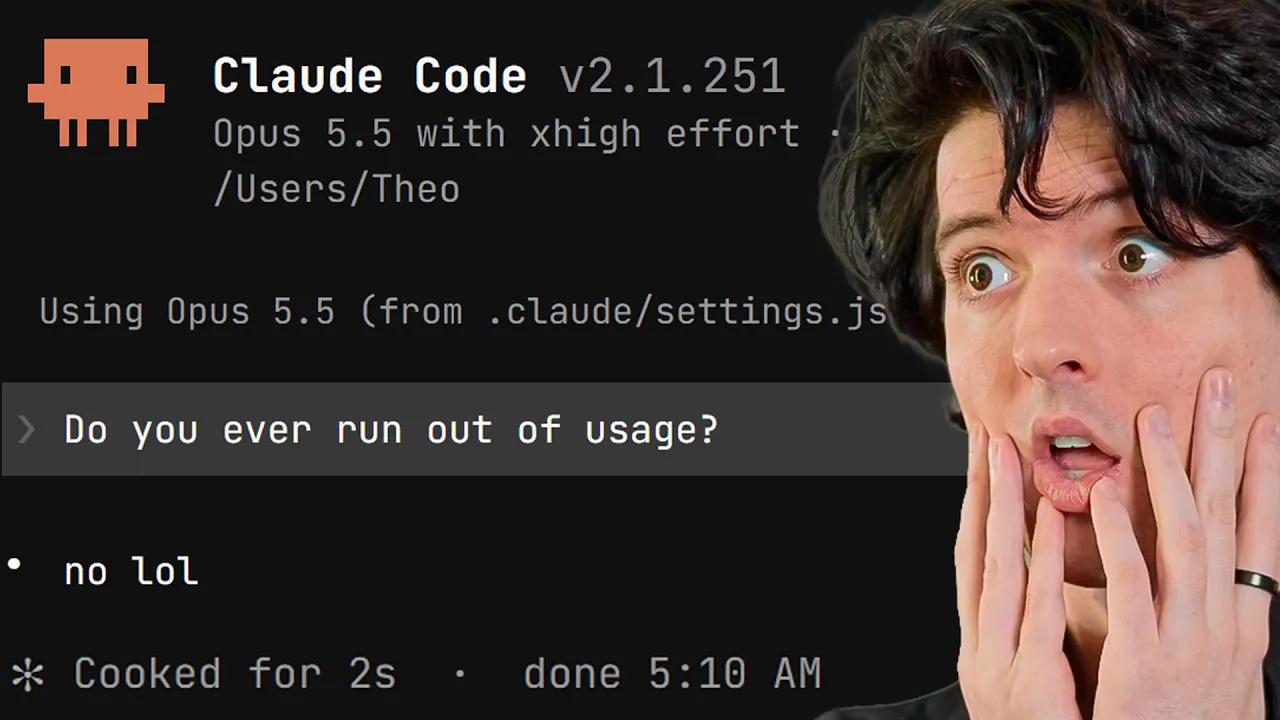
Theo explains how he keeps coding agents working for days or weeks through verifiable goals, automated feedback, and expandable compute. Skate 3 Bench, TS Rust, and Lust illustrate both the results and the costs of that approach. This is an opinion-led technical walkthrough with case studies, rather than a reproducible setup tutorial. He explicitly discourages copying the workflow. 1:48
Video: Theo - t3․gg on YouTube, 38:47. Local source: complete transcript. Measurements and prices below are reports from the video, not independently verified benchmarks or current offers.
Topic breakdown
- Scope, spending, and agent tools, 0:00–4:15.
- Skate 3 Bench: a playable game built by agents, 4:15–8:28.
- Hill climbing, verifiable rewards, and TS Rust, 8:28–14:03.
- Screenshot judges and the limits of visual feedback, 14:03–17:52.
- Choosing tasks, verification, and resources, 17:52–22:28.
- Compute bottlenecks and Blacksmith offloading, 22:28–26:25.
- Boat sandboxes, snapshots, and parallel validation, 26:25–32:01.
- Managing agents by removing blockers, 32:01–34:35.
- Lust, recursive optimization, and closing cautions, 34:35–38:47.
The recurring loop
The workflow combines an agent's implementation/verification loop with a human's repeated effort to remove resource bottlenecks. 21:09 32:54
flowchart TD
    A[Choose a task] --> B[Define checkable success]
    B --> C[Supply tools and compute]
    C --> D[Agent implements and verifies]
    D --> E{Meets the goal?}
    E -->|No| D
    D --> F[Ask what blocks progress]
    F --> C
    F --> G[Turn a bottleneck into a new project]
    G --> A
    E -->|Yes| H[Set a harder measurable goal or finish]
Key takeaways
- Clear reference outputs made TS Rust tractable: match a pinned TypeScript version first, then pursue a 2× speed target while keeping validation passing. Theo reports the agent reached that target.
12:4013:0913:37 - Skate 3 Bench ran for four days with 25 human prompts and produced a playable browser game. Its reported inference equivalent was nearly $5,000; visual judges helped iteration but did not eliminate gameplay defects.
5:096:397:0616:06 - Subscription usage and API-equivalent costs are different figures. Theo estimates TS Rust at roughly $38,000–$40,000 in API-equivalent usage versus $500–$800 of subscriptions, with over $2,000 in separate Blacksmith compute.
19:0822:2824:14 - Offloading TS Rust checks to Blacksmith reduced reported compute waiting per run from upwards of 12 hours to 1.2 hours, though individual builds still took 20–40 minutes.
25:0525:30 - Boat reduced a reported Lust validation gate from 70 minutes to 353 seconds, about six minutes; Theo says daily code throughput nearly tripled.
30:11 - Lust reportedly reduced one TS Rust build from 17 minutes to 12 seconds, but barely supported that project and was not expected to work for other applications.
34:35 - The ongoing human task is to ask what blocks the agents and improve their environment. Removing compute limits also increases subscription consumption.
32:5433:47