ByteMonk · 10:49 · https://www.youtube.com/watch?v=XjHZCprrEgk
Summary
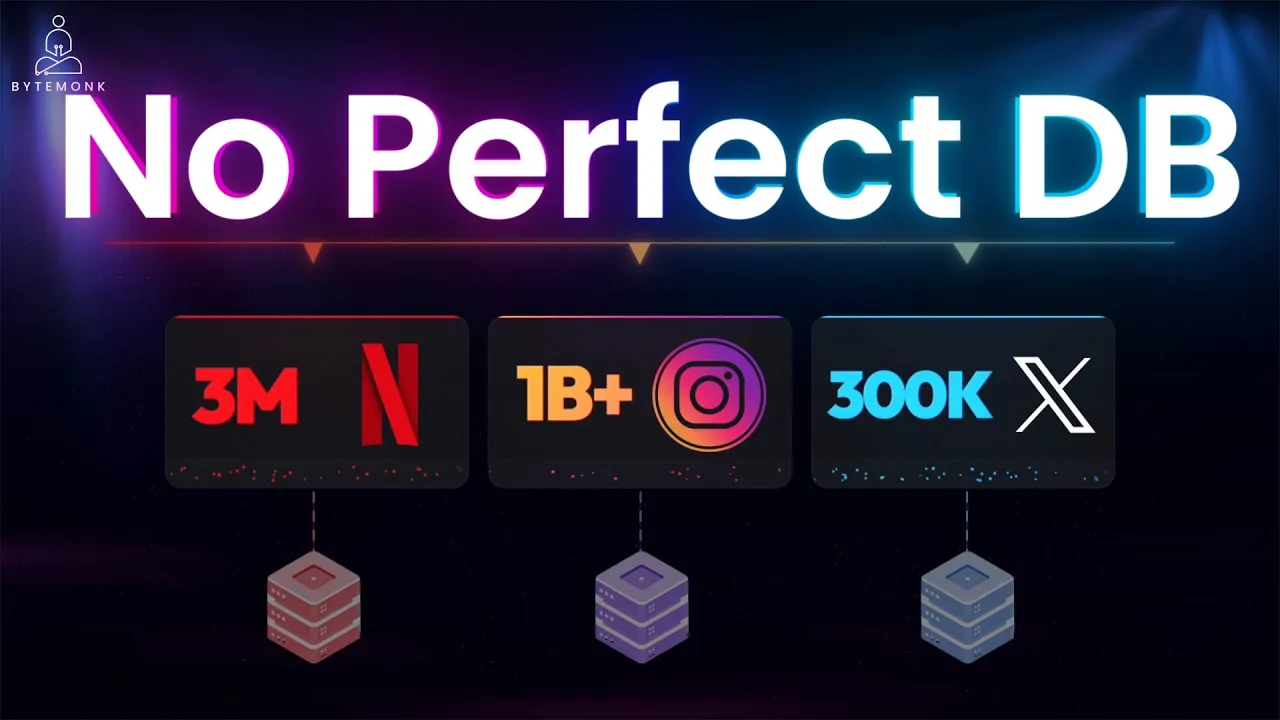
A system design explainer that reverse-engineers the database choices of three large platforms — Netflix (Cassandra), Instagram (PostgreSQL) and Twitter (Redis) — and argues that none of them is "the best database": each was chosen because it matched that company's access pattern. For each case the video walks through the workload, the internal mechanics that make the chosen database fit, the trade-off accepted in exchange, and what would have broken with a different choice. It closes with a three-question framework for making the decision yourself, plus a warning against copying big-tech architecture at small scale.
flowchart TD
    A[Access pattern drives the choice] --> N[Netflix<br/>3M+ writes/sec]
    A --> I[Instagram<br/>read-heavy relational]
    A --> T[Twitter<br/>instant timelines]
    N --> NC[Cassandra<br/>write throughput, denormalized]
    I --> IP[PostgreSQL<br/>joins, aggregation, pagination]
    T --> TR[Redis cache<br/>pre-computed, in-memory]
    NC --> F[Three-question framework]
    IP --> F
    TR --> F
Topics
- Three Companies, Three Choices
- Netflix and Cassandra: Write Throughput at Scale
- Instagram and PostgreSQL: Relational Access Patterns
- Twitter and Redis: Pre-computed Timelines
- The Three-Question Framework for Choosing a Database
- Final System Design Takeaways
Key takeaways
- Database choice is driven by access pattern, not by an absolute ranking — the database that is perfect for one company would be a disaster for another (
0:00,0:25) - Netflix's 260 million subscribers generate 3+ million writes/sec; Cassandra absorbs it because a write is a hashed partition-key route into an in-memory memtable, acknowledged with no locks and no cross-node coordination (
0:56,1:22,1:46) - The price Netflix pays: no joins, no ad hoc queries, and the same data stored several times in query-shaped tables — denormalization is the strategy, not a bug (
2:10,2:26,2:46) - Using Cassandra like a relational database (multi-partition queries, secondary indexes) produces ~200 ms read latencies — a design failure, not a database failure (
2:46) - Postgres at Netflix's write volume would need an army of instances plus a complex sharding layer; Cassandra gives horizontal write scaling natively (
3:06) - Instagram ran its whole backend on PostgreSQL past a billion users because its workload is read-heavy and relational: joins, aggregations, filtering and sorted pagination (
3:59,4:16) - Making Postgres hold up took four concrete techniques: PgBouncer connection pooling, read replicas, table partitioning and indexing tuned to avoid full table scans (
4:53,5:20) - With Cassandra, every new feature would demand a new denormalized pipeline; with Postgres it is a new query — flexibility is a product-velocity feature, not just a technical one (
4:37,4:53) - Instagram still uses other stores for messaging, real-time notifications and analytics — the win was not abandoning Postgres for the core use case (
5:47) - Twitter serves timelines from Redis at 300,000+ requests/sec per node by fanning out on write: each tweet is pushed into every follower's cached list, so reads are microsecond RAM lookups with no disk, parsing or index work (
6:37,7:00,7:18) - Redis is never the source of truth: write to the durable store first, replicate to Redis, read from Redis, fall back on failure — Redis can lose data on restart by default (
7:29,7:51) - The celebrity case breaks pure fan-out-on-write (80 million list updates for one tweet), so Twitter uses a hybrid: fan-out on write for regular users, fan-out on read for celebrities, merged at request time (
8:09,8:34) - The decision framework is three questions: what is the access pattern, what are you willing to sacrifice, and do you actually need it (
8:53,9:18,9:44) - Explicit trade-off map: Postgres = flexibility vs. write throughput, Cassandra = write scale vs. query flexibility, Redis = speed vs. durability and capacity (
9:18) - A well-indexed PostgreSQL handles more load than 95% of applications will ever see — don't adopt Cassandra at 10,000 users just because Netflix uses it (
9:44) - All three companies were right at once, because the real skill is matching data, queries and trade-offs to a tool — not memorizing which database is fastest (
10:03,10:19)