Design the system that makes decisions
- Interfaces increasingly emerge without a designer present: agents find and fix problems unattended, and generative UI appears in real time. Standards must therefore explain decisions that designers previously filled in from shared understanding.
9:069:26 - Dill shifts the object of design from individual screens to the system that produces them. Her distinction: older systems scaled consistency; newer systems must scale intent.
9:5610:45 - Her printing analogy describes Gutenberg's 290 characters, including width variants, abbreviations, and ligatures. Those options supported justified text without distracting white-space gaps. The design lesson is to make production systems extensible and opinionated enough to preserve craft.
9:5610:25
Stripe's progression
- Initial approach: an MCP that understood design documentation. Dill says it lacked specificity; three people could enter the same prompt and receive three different results.
11:09 - Revised approach: a CLI built on Stripe's design system, used where builders work. It consumes documentation at the relevant time and place to avoid context rot and better constrain AI behavior.
11:27 - Broader design knowledge: full templates and flows alongside components and atomic parts. These express how the product should behave and how its pieces fit together, making the system more opinionated.
11:45
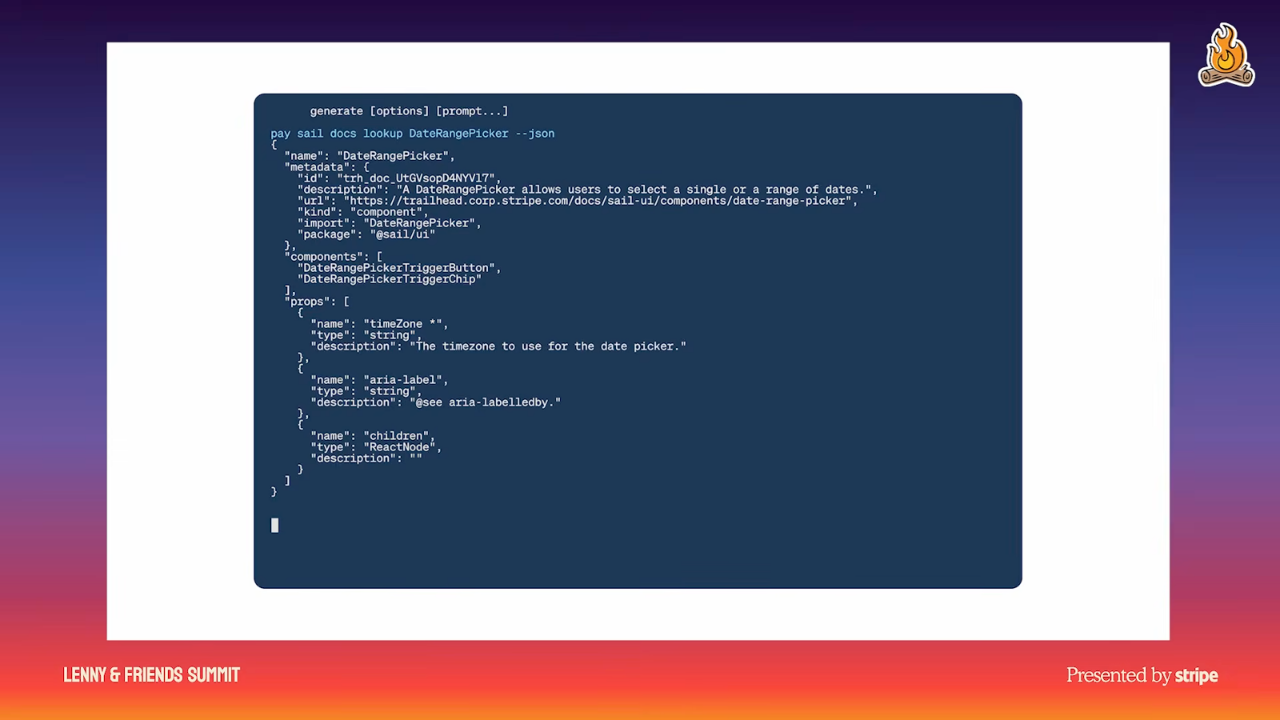
Figure 4. Stripe's CLI brings design documentation into the building workflow. The displayed lookup returns structured information about a date-range picker. 11:27

Figure 5. The design system provides guidance beyond individual components. Templates and flows describe how product behavior and complete experiences fit together. 11:45
Result and limit
- Stripe's aim is nearly instantaneous movement from prompt to production. Dill says embedding standards into production tools supports a more coherent product, while acknowledging that the team is still working through problems. The talk provides no quantified CLI evaluation.
10:4511:45 - Rule compliance is a baseline. Dill invokes Christopher Alexander's warning that a system can satisfy every rule and still feel dead, motivating a separate editorial quality check.
12:10