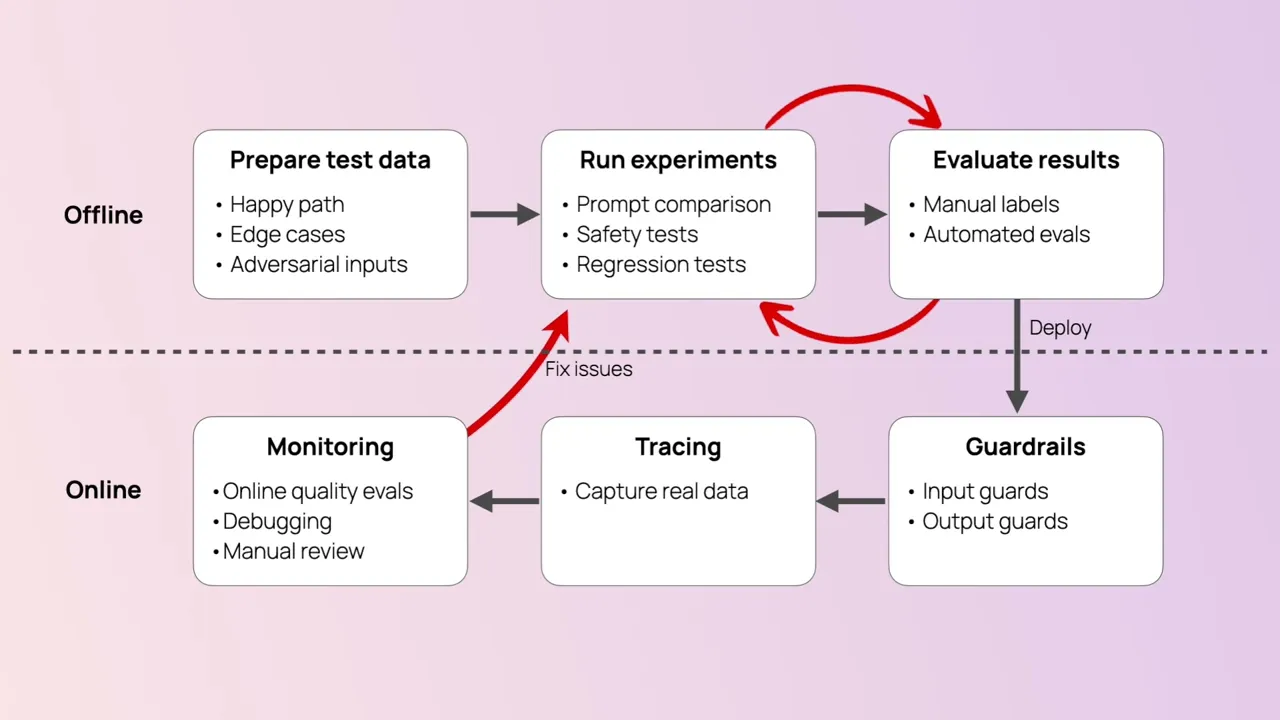
Final video of the Evidently AI LLM evaluation course (2:33). It recaps the two kinds of evals covered in the course — evaluating LLM models and evaluating LLM systems built on them — and connects everything into a single end-to-end workflow: evaluation datasets → experimental iteration → deployment with guardrails → production observability → feeding failures back into the datasets. The result is a continuous improvement loop where real user data strengthens the tests, and solid tests drive smart product decisions.
Topics
- Course recap: why evaluations matter
- The evaluation workflow, end to end
- The continuous improvement loop
- Summing up
flowchart LR
    A[Evaluation datasets<br/>key scenarios, edge cases, safety risks] --> B[Experimental cycle<br/>test models, prompts, configs]
    B --> C[Deploy<br/>+ guardrails]
    C --> D[Observability<br/>collect real data, run evals]
    D -->|issue found| B
    D -->|new failure cases| A
Key takeaways
- Evaluations matter because they let you move faster, prevent failures, and deliver value to users — the end goal is a system of measurable continuous improvements to your product
0:18,0:34. - The workflow is a cycle: build evaluation datasets from key scenarios, edge cases, and safety risks; iterate over models, prompts, and configurations; start with manual evaluations and scale to automated metrics
0:47. - After deployment, observability is essential: collect real interaction data, run evals over it, return to the experimental cycle when something breaks, and deploy fixes only after regression tests
1:05. - New production failure cases must be fed back into the evaluation datasets — the data itself becomes your major asset
1:35. - Enough labeled data eventually enables two upgrades: replacing LLM-as-a-judge with smaller fine-tuned evaluators, and fine-tuning your main LLM for your specific use case
1:48,2:04. - Evaluations are a core part of the AI product, not just metrics — start small, but start: "An AI product without evaluations is the product no one cares about"
2:10.