ByteMonk · 15:52 · Watch on YouTube
Summary
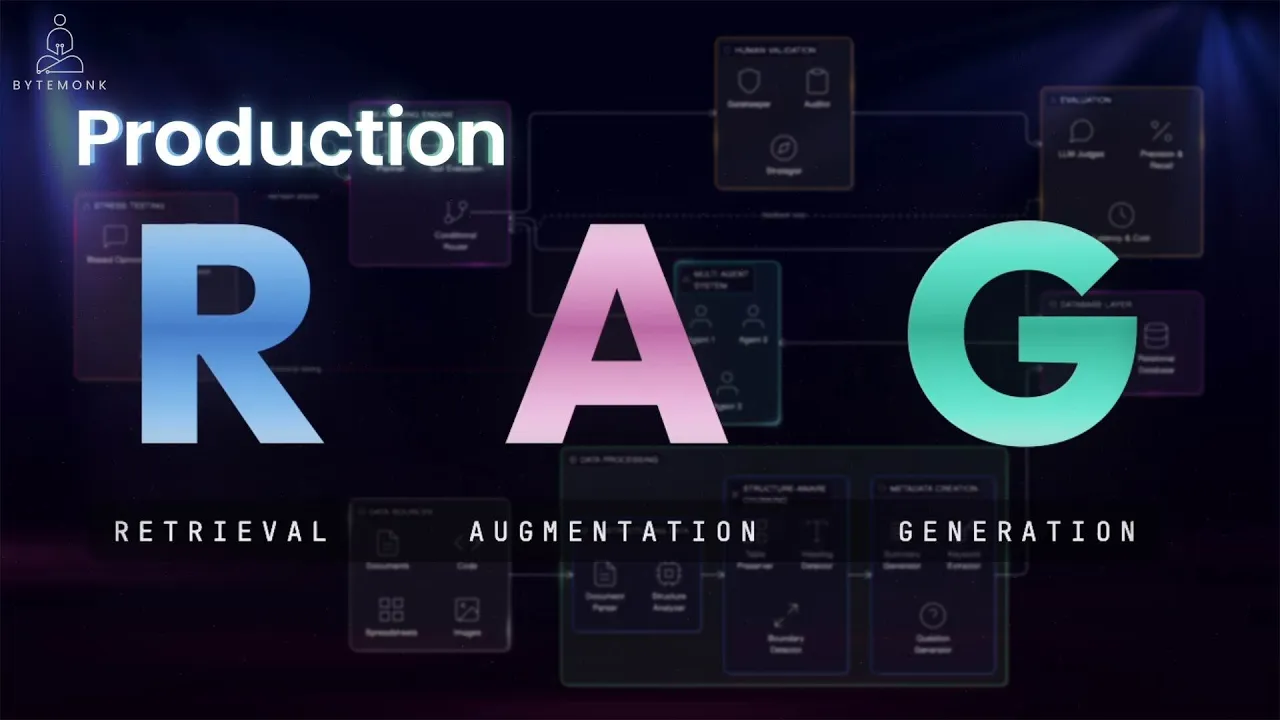
An architecture walkthrough of what a production-grade RAG system looks like, versus the four-step demo version (chunk → embed → retrieve → generate) found in most tutorials. The video starts from a counterintuitive premise — bad retrieval makes an LLM hallucinate more than no retrieval at all — and uses it to justify each additional layer: structure-aware ingestion, metadata and hypothetical-question generation, a database that holds vectors and relational data, hybrid semantic+keyword retrieval, a planner-driven reasoning engine with specialized agents, a three-node validation layer, evaluation metrics, and red teaming. It includes a sponsored segment on Neon (serverless Postgres + pgvector).
flowchart TB
    subgraph W["Why the extra layers exist"]
        B[Bad retrieval → more hallucination] --> G[Demo RAG ≠ Production RAG]
    end
    G --> I["1 · Ingestion<br/>restructure + structure-aware chunking + metadata"]
    I --> D["2 · Storage<br/>vectors + relational in one DB"]
    D --> R["3 · Retrieval<br/>hybrid search + re-rank"]
    R --> RE["4 · Reasoning<br/>planner + tools + multi-agent"]
    RE --> V["5 · Validation<br/>gatekeeper · auditor · strategist"]
    V --> U[User]
    V --> E["6 · Evaluation<br/>qualitative · quantitative · performance"]
    RT["0 · Red teaming<br/>break it before users do"] -.-> RE
Topics
- What Is RAG and Why It Exists
- Why Bad Retrieval Causes Hallucinations
- Demo RAG vs Production RAG
- Production RAG Architecture — Full Overview
- Data Ingestion & Smart Chunking
- Metadata, Summaries & Question Generation
- Why You Need Vector + Relational Databases
- PostgreSQL + pgvector in Production
- Hybrid Search (Semantic + Keyword)
- Reasoning Engine & Multi-Agent Systems
- Validation Layer — Stopping Hallucinations
- Evaluation Metrics
- Red Teaming & Stress Testing
Source: transcript.md
Key takeaways
- Bad retrieval is worse than no retrieval. A cited Google Research study found that when retrieval is off, the LLM hallucinates more than if it had been given no context at all (
0:37). - Context makes an LLM more confident, not more honest. It does not say "I don't know" when the context is weak — it fills gaps with plausible-sounding invented content, producing a confidently wrong system (
3:26). - Retrieval can "succeed" and still be wrong in three distinct ways: stale document versions, chunks split mid-criteria, and tables destroyed during text extraction (
2:46). - Chunk size converges to 256–512 tokens with overlap, but the video's stated conclusion is that the exact number matters less than respecting document structure (
6:45). - Ingestion quality is a hard ceiling: if data is poorly structured going in, nothing downstream can fix it (
7:39). - Generating hypothetical questions per chunk turns retrieval into question-to-question matching, which the video states works much better than matching a question against a random paragraph (
7:09). - A vector store alone can't do production retrieval — filtering by date/department/type and joining chunks to parent documents are relational operations, hence Postgres + pgvector as one system instead of two (
8:10,8:30). - Database branching lets you A/B a new chunking strategy or embedding model against a full copy of the knowledge base without touching production — "Git for your database" (
9:42,10:07). - Market data point (sponsored segment): Neon was acquired by Databricks for ~$1 billion, with Databricks citing that over 80% of databases created on Neon are provisioned by AI agents, not humans (
9:06,9:23). - Most production systems now run hybrid search plus re-ranking — vectors for meaning, keywords for exact matches like product names and error codes (
10:33). - Multi-part analytical queries are not a single retrieval. A "compare Q3 Europe vs Asia and recommend" question requires a planner, a tool-execution layer, and reasoning across several sources — this is what "agentic RAG" means (
11:15,12:00). - Added reasoning complexity adds new failure modes, which is why a conditional router runs every response past a gatekeeper (does it answer?), an auditor (is it grounded?), and a strategist (does it make sense?) before the user sees it (
12:25,12:49). - Evaluation splits into three measurable tracks — LLM judges for faithfulness/relevance/depth, retrieval precision and recall, and latency/token cost. Without them you're flying blind while users quietly get bad answers (
13:42,14:05). - Red teaming is framed as non-optional for any system touching real users or business decisions, testing three specific vectors: prompt injection, information evasion, and biased/harmful outputs (
14:22,14:55).