The Pragmatic Engineer · 1:25:49 · Watch on YouTube
Summary
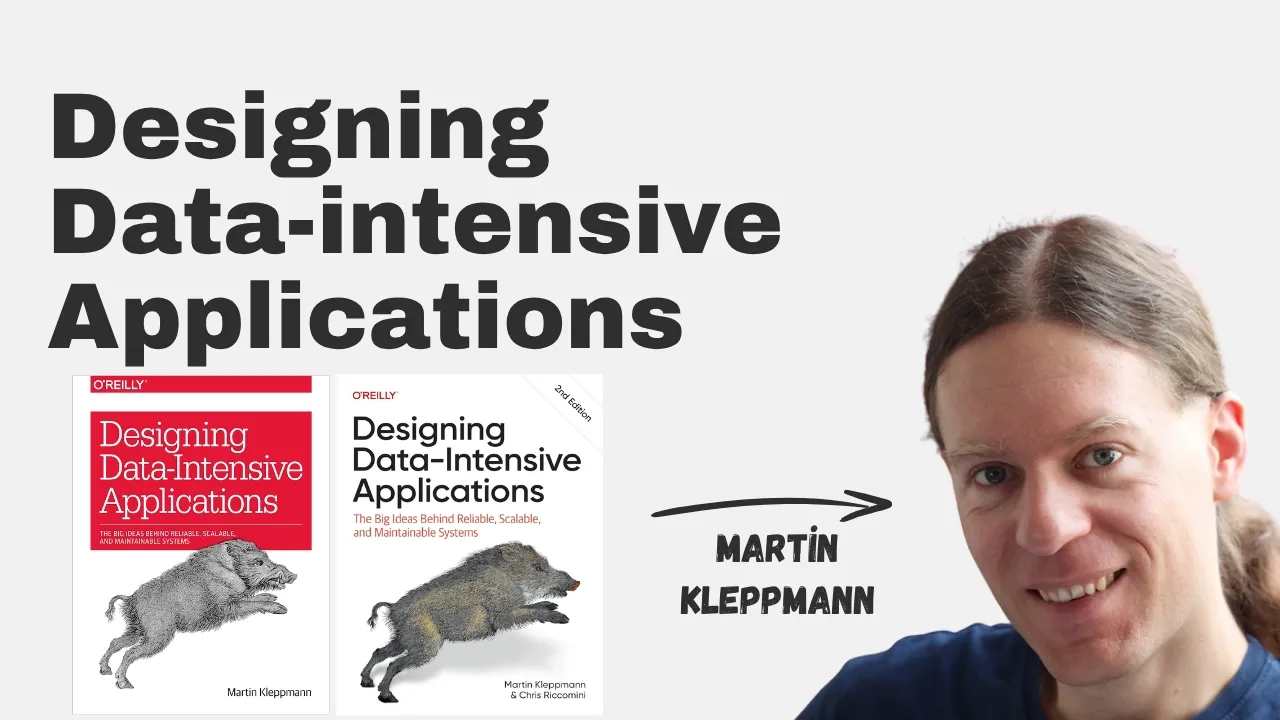
An interview with Martin Kleppmann, author of Designing Data-Intensive Applications (DDIA), on the occasion of the book's second edition — 9 years after the first. The conversation traces his path from two UK startups (GoTest.it, Rapportive) through the LinkedIn acquisition and his work on Kafka/Samza-era data infrastructure, which directly shaped the book. It then digs into what changed in the second edition (cloud-native architecture on object stores, MapReduce removed, vector indexes and data frames added), the trade-offs of building on managed cloud services, why formal verification may matter more in the age of AI-generated code, and his academic research on local-first software and supply-chain cryptography.
Topics
- Early career
- Building Rapportive
- Working at LinkedIn
- Writing Designing Data-Intensive Applications
- Reliability, scalability, and maintainability
- DDIA: the second edition
- Tradeoffs of using cloud services
- How the cloud changed scaling
- The trouble with distributed systems
- Ethics for software engineers
- Formal verification
- Academia vs. industry
- Local-first software
- Computer science education
- Martin's current research and advice
flowchart TD
    A[Career arc<br/>startups → LinkedIn → academia<br/>topics 1–3] --> B[The book<br/>writing DDIA · its core concepts<br/>topics 4–5]
    B --> C[Second edition<br/>cloud-native · what changed<br/>topics 6–9]
    C --> D[Bigger questions<br/>ethics · formal verification<br/>topics 10–11]
    D --> E[Academia<br/>local-first · education · research<br/>topics 12–15]
Key takeaways
- Kafka was built at LinkedIn for data integration, not messaging: an append-only log as a general-purpose "lowest common denominator" connecting many data sources to many downstream consumers (data warehouse, Hadoop/ML).
12:47 - The first edition of DDIA took ~4 years to write (~2.5 years full-time equivalent), missing the publisher's deadline by about 2.5 years.
21:55 - LinkedIn gave Kleppmann 50% of his work time to write the book — and even that failed due to context switching with on-call duty; the book required going full-time.
14:5215:29 - The defining shift for the second edition: the first edition assumed machines with local disks and database-level replication; today databases are built on top of object stores, a genuinely new abstraction where replication happens at the object-store level — an idea integrated throughout the whole book.
29:0329:33 - "MapReduce is dead. Nobody uses it anymore" — its detailed coverage was cut in the second edition (successors Spark and Flink are what's used), while vector indexes and data frames were added to support AI workloads.
47:1147:55 - Scalability now includes scaling down: cost should be proportional to load at both ends, and serverless is the innovation that made near-zero-load services viable — the cloud helped more at the low end than at the high end, where sharding still requires real engineering.
25:3739:5940:21 - Cross-machine sharding is less pressing mostly because hardware got more powerful, not because of the cloud; replication remains relevant at every scale since it serves fault tolerance, not scalability.
41:4342:22 - European dependence on US cloud providers is now a named business risk — "fairly unlikely, but no longer unthinkable" — and multi-cloud setups are worth serious consideration for critical workloads.
37:1638:16 - Kleppmann's AI-era case for formal verification is two-sided: LLMs make proofs cheaper to write, and AI-generated code makes automated correctness checking necessary because human review becomes the bottleneck; only proofs cover every possible case, which matters when one bug breaks the security of the whole system.
58:3558:5859:25 - Getting-started advice for formal methods: begin with model checking (TLA+), which is much friendlier than proof assistants like Isabelle, Rocq, or Lean.
57:34 - Decentralized access control is nearly solved without consensus in Automerge (the CRDT library Kleppmann works on), preserving offline work and peer-to-peer sync; clocks can't be trusted for ordering because revoked users can backdate edits.
1:06:441:07:39 - On AI and learning, he endorses the principle behind a recent Anthropic study: juniors who leaned on AI showed little to no learning versus those who didn't — "to learn something you just have to struggle with it a bit".
1:16:211:16:42 - Career advice: industry and academia aren't mutually exclusive — the best PhD students often have industry experience, and weaving between the two builds both breadth and first-principles rigor.
1:22:361:24:09