Harvard University · 1:25:02 · Watch on YouTube
Summary
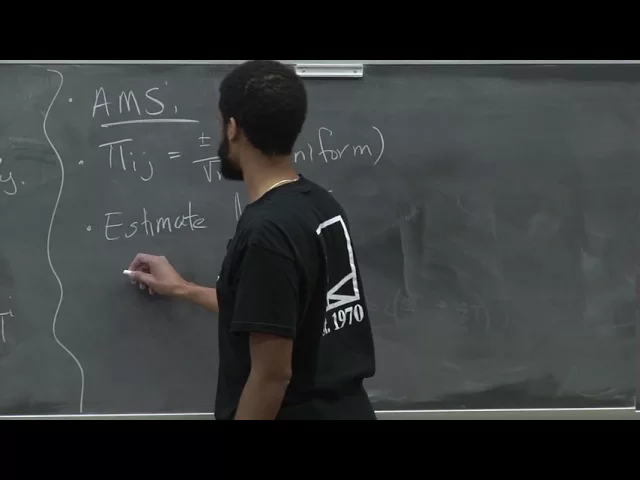
The final lecture of the course, which Jelani Nelson titles "the power of random signs": one object — a matrix Π whose entries are random ±1/√m — solves four apparently unrelated problems. He builds it first as the AMS sketch for estimating ‖x‖₂² in a stream, proving unbiasedness and an O(‖x‖₂⁴/m) variance so Chebyshev gives m = O(1/ε²), then amplifying with the median trick to O((1/ε²)·log(1/δ)) space (which is optimal), and noting that 4-wise independence is all the proof ever used, so Π fits in a handful of words. The Thorup–Zhang variant — one random signed non-zero per column — keeps every guarantee while cutting update time from O((1/ε²)log(1/δ)) to O(log(1/δ)), a factor-10,000 saving that mattered when AT&T ran it on routers for denial-of-service detection. The same matrix is then reused for cosine similarity, for ε-subspace embeddings that turn O(nd²) least-squares regression into O(md²) with m = O(d²/ε²), for the Johnson–Lindenstrauss lemma (m = O((1/ε²)log N), proved by taking the log(1/δ)-th moment instead of the second), and finally for point query via incoherent matrices built by applying JL to the standard basis.
Topics
- Lecture plan and the streaming model
- Linear sketching and why it supports deletions
- The AMS sketch: expectation, variance, Chebyshev
- Median amplification, optimal space, and limited independence
- Update time and the Thorup–Zhang sparse sketch
- Applications: DoS detection and cosine similarity
- Fast least-squares regression via subspace embeddings
- What a subspace embedding really is (and how to build one)
- Dimensionality reduction: the Johnson–Lindenstrauss lemma
- Point query via incoherent matrices
flowchart TD
    P["Π: random signs ±1/√m<br/>store y = Πx"] --> N["Π preserves ‖·‖₂²<br/>(E + Var + Chebyshev)"]
    N --> L2["L2-norm estimation<br/>O((1/ε²)log(1/δ)) space — optimal"]
    N --> DP["preserves norms ⇒<br/>preserves dot products"]
    DP --> CS["cosine similarity<br/>of documents"]
    P --> TZ["Thorup–Zhang:<br/>1 non-zero per column"]
    TZ --> DoS["DoS detection on routers<br/>update time O(log 1/δ)"]
    N --> SE["ε-subspace embedding<br/>‖(ΠU)ᵀΠU − I‖_op < ε"]
    SE --> REG["least-squares regression<br/>O(nd²) → O(md²), m = O(d²/ε²)"]
    N --> JL["JL lemma (high moment)<br/>m = O((1/ε²) log N)"]
    JL --> PQ["point query<br/>via incoherent Π"]
    DP --> PQ
Key takeaways
- The AMS sketch is unbiased with variance
O(‖x‖₂⁴/m), so Chebyshev plusm = 6/ε²yields a(1 ± ε)estimate of‖x‖₂²with probability2/3inO(1/ε²)words27:13,28:58. O((1/ε²)·log(1/δ))space is optimal for L2-norm estimation — reached by stackinglog(1/δ)copies and taking the median (Chernoff), and proved optimal only after a long chain of papers ending at Jayaram–Woodruff32:40,33:39,34:02.- The sketch matrix never has to be stored: the whole analysis is degree-4 in the signs, so 4-wise independence suffices, and a 4-wise family costs
O(log n)bits — about one word per copy,O(log(1/δ))words total35:22,36:18. - Thorup–Zhang's one-non-zero-per-column sketch is strictly better than dense AMS: identical space and accuracy, but update time drops from
O((1/ε²)log(1/δ))toO(log(1/δ)). At 1% error that removed a factor of1/ε² = 10,000from AT&T's per-packet cost for DoS detection on routers38:56,40:26,40:50,44:03. p = 2is the ceiling:‖x‖_∞— the norm that best detects traffic spikes — admits no space-efficient streaming algorithm, and2is the largestpfor whichLpestimation is space-efficient43:17,43:37.- Subspace embeddings make least squares dimension-free in
n: solvingargmin‖ΠAx − Πb‖gives residual within(1+ε)/(1−ε)of optimal, withm = O(d²/ε²)rows (Clarkson–Woodruff, tightened by Mahoney–Meng and Nelson–Nguyen), turning theO(nd²)AᵀAbottleneck intoO(md²)— plusO(nnz(A))to formΠAwith a sparseΠ57:45,1:00:07,1:09:32,1:10:21,1:11:06. - JL's
m = O((1/ε²)·log N)is optimal for linear sketches, in the formΩ(min{n, (1/ε²)log N})— theminonly becauseΠ = Iis always available. The proof is the AMS computation with thelog(1/δ)-th moment in place of the second, then a union bound over allN choose 2pairs1:13:37,1:14:16,1:17:05,1:18:31. - Preserving L2 norms ⇒ preserving dot products (via
⟨a,b⟩ = (‖a‖²+‖b‖²−‖a−b‖²)/2) is the single lever behind cosine similarity, subspace embeddings, and point query alike47:40,48:43,1:23:26. - Point query in
O((1/ε²)·log n)rows: applying JL to{0, e₁, …, eₙ}produces unit columns with pairwise inner products≤ ε, and(ΠᵀΠx)ᵢ = xᵢ ± ε‖x‖₁1:22:24,1:22:51. - Open problem flagged by the lecturer: whether L2-norm estimation can achieve optimal space with update time below
log(1/δ)— linear sketches provably need about√(log(1/δ)), leaving a gap41:22,41:41.