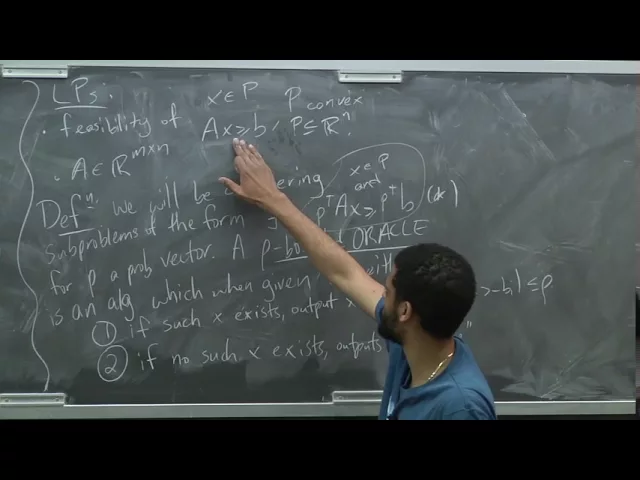
Harvard University · 1:23:37 · https://www.youtube.com/watch?v=TdTFYVjzs1I
A two-part lecture. The first half closes out multiplicative weights by showing how it approximately solves linear programs: the m LP constraints become the "experts", a ρ-bounded oracle answers a one-constraint relaxation each day, and the average of the oracle's answers is an almost-feasible point. Fractional set cover is worked through end to end as a concrete instantiation. The second half opens a new topic, max flow — the definitions, the LP formulation and what interior point methods buy for it, and finally Ford–Fulkerson with residual graphs and augmenting paths.
flowchart TD
    subgraph MW["Part 1 — Multiplicative weights (finishing up)"]
        T1["1. MW recap & regret"] --> T2["2. LP feasibility + ρ-bounded oracle"]
        T2 --> T3["3. MW for LPs: theorem & proof"]
        T3 --> T4["4. Worked example: fractional set cover"]
    end
    subgraph FL["Part 2 — Flows (new topic)"]
        T5["5. Max flow: definitions & LP"] --> T6["6. Solving max flow via LP machinery"]
        T6 --> T7["7. Ford–Fulkerson"]
    end
    T4 --> T5
    T7 --> NEXT["Next lecture: faster flow algorithms"]
Topics
- Multiplicative weights recap and regret
- LP feasibility and the ρ-bounded oracle
- Multiplicative weights for LPs: theorem and proof
- Worked example: fractional set cover
- Max flow: definitions and LP formulation
- Solving max flow with LP machinery
- Ford–Fulkerson: augmenting paths and residual graphs
Key takeaways
- Given a ρ-bounded oracle with
ρ > ε/2, multiplicative weights returnsx ∈ PwithAx ≥ b − ε·𝟙inO(ρ² log m / ε²)iterations — the LP'smconstraints play the role of experts and the output is the average of the oracle's per-iteration answers (15:41,29:29). - The proof is a squeeze: the oracle's guarantee forces
⟨m_t, p_t⟩ ≥ 0while the MW regret bound caps it from above; choosingη = ε/(2γ)andT = 4γ² ln m / ε²makes both error termsε/2(22:29,27:32,28:35). - For fractional set cover the oracle is trivial — put all
βmass on the set maximizingp(S) = Σ_{e∈S} p_e— which givesρ ≤ β ≤ mand henceO(m² log m / ε²)MW iterations for a(1+ε)-approximate solution, withβfound by binary search over[1, m](37:03,41:18,41:38,42:06). - Max flow is exactly an LP, and a generic interior point method solves it in about
O(m^{3.5} L)because each of the√mNewton steps is a linear system solve costingm³(53:21,1:00:31). - Exploiting flow structure beats the generic bound twice over: Daitch–Spielman (STOC 2008) solve the flow-induced (Laplacian-like) systems in
Õ(m), givingm^{3/2} log² U, and Lee–Sidford's weighted barrier turns the√miteration count into√n, givingm√n(1:01:44,1:02:43,1:04:39). - Ford–Fulkerson's
O(m · f*)scales with the flow value, not the graph size — a small graph with billion-scale capacities can force ~a billion steps — and its correctness rests on:f*is maximum iffsandtare disconnected in the residual graphG_{f*}(1:05:32,1:06:35,1:21:21).