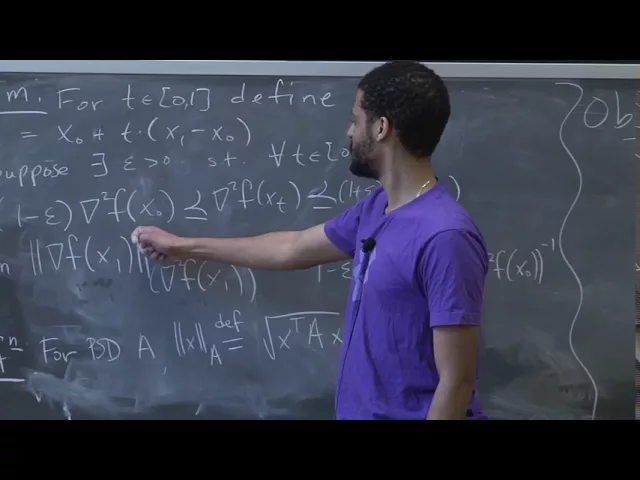
Harvard University · 1:24:42 · Watch on YouTube
Summary
This lecture completes the analysis of the interior point method (IPM) for linear programming by supplying its missing engine: Newton's method, a second-order optimization method with oracle access to f, ∇f, and ∇²f. The first half states and proves a progress theorem — if the Hessian is spectrally stable along the segment between consecutive iterates (within a factor 1 ± ε), one Newton step shrinks the gradient's Hessian-norm by a factor ε/(1−ε). The second half plugs that theorem into IPM: it defines centrality as the progress measure, proves that the Hessian of the log-barrier objective is stable precisely because the centrality is small, and derives the classic λ ← (1 + 1/√m)·λ step size, giving ≈ √m·L outer iterations. The lecture closes with the current best bound (√rank(A)·L, via Lee–Sidford's weighted barrier) and a sketch of how to construct the initial central point.
Classification: educational video — a university lecture in a theory course, structured as theorem → proof → application.
Topic breakdown
- Recap: Interior Point and Second-Order Methods — the LP setup, the barrier objective
f_λ, and what a second-order oracle is. - Newton's Method: the Update Rule and Where It Comes From —
x₁ = x₀ − (∇²f)⁻¹∇fas the minimizer of the second-order Taylor model. - The Progress Theorem and the Hessian Promise — the
1 ± εLoewner sandwich along the segment, and the‖·‖_Anorm. - Preliminary: Rewriting the Spectral Sandwich — whitening
(1−ε)A ⪯ B ⪯ (1+ε)Ainto−εI ⪯ A^{−1/2}(B−A)A^{−1/2} ⪯ εI. - Proof of the Newton Progress Theorem — FTC, norm swap, whitening, and the
M² ⪯ ε²Ibound. - Back to Interior Point: Centrality, Fine and Coarse —
∇f_λ,∇²f_λ, and the1/100vs1/3thresholds. - Verifying Newton's Hypothesis: How Much the Hessian Moves — reducing Hessian stability to slack stability, and showing
ε = δ(x₀). - How Fast Can
λGrow? The1 + 1/√mBound — the add-and-subtract trick, the projection-matrix bound√m, and the iteration count. - State of the Art: Lee–Sidford's Weighted Barrier — why the unweighted barrier double-counts constraints, and the
√rank(A)improvement. - Initialization: Getting the First Central Point — the augmented LP′, the fake-cost trick, and running the IPM in reverse.
graph TD
    subgraph P1["Part 1 — Newton's method"]
        A["2nd-order oracle<br/>(1–2)"] --> B["progress theorem:<br/>Hessian stable ⇒ gradient shrinks<br/>(3)"]
        B --> C["whitening lemma<br/>(4)"]
        C --> D["proof: ‖∇f(x₁)‖ ≤ ε/(1−ε)·‖∇f(x₀)‖<br/>(5)"]
    end
    subgraph P2["Part 2 — Interior point"]
        E["centrality δ_k(x)<br/>fine 1/100 · coarse 1/3<br/>(6)"] --> F["Hessian stability ⇐ δ ≤ 1/3<br/>(7)"]
        F --> G["λ ← (1+1/√m)λ<br/>≈ √m·L iterations<br/>(8)"]
        G --> H["√rank(A)·L via weighted barrier<br/>(9)"]
        G --> I["how to start: LP′ + reverse IPM<br/>(10)"]
    end
    D --> E
Key takeaways
- One Newton step contracts the gradient by
ε/(1−ε)in the Hessian-inverse norm, provided the Hessian stays within(1±ε)·∇²f(x₀)everywhere on the segment fromx₀tox₁8:13,11:22,33:20. - The Hessian of the log-barrier objective
∇²f_λ(x) = AᵀS(x)⁻²Adoes not depend oncorλ— only on the slacks — so Hessian stability reduces entirely to slack-matrix stability34:59,44:01,58:06. - The
εin Newton's hypothesis equals the centrality of the starting point: along the Newton segment the relative slack change is at mostt·δ(x₀) ≤ δ(x₀). Starting coarsely central (δ ≤ 1/3) givesε = 1/3 < 1/2, hence a contraction factor of1/2per step andO(1)steps to return from1/3to1/10040:05,51:44,52:16,53:45. λcan be multiplied by1 + Θ(1/√m)per outer step. The boundδ_{k+1} ≤ (1+α)·δ_k + α√mcomes from an orthogonal-projection argument (‖𝟙‖₂ = √m); requiringδ_{k+1} ≤ 1/3fromδ_k ≤ 1/100forcesα ≈ 1/(10√m)1:10:58,1:11:33,1:12:05.- Total outer-loop cost is
≈ √m·Literations, drivingλfrom roughlyexp(−L)up tom·exp(L)for precisionL; the best known bound improves this to√rank(A)·L(Lee–Sidford), by replacing the barrier with a weighted one so that duplicated constraints are not over-counted — making algorithmic an earlier non-constructive existence result of Nesterov (and Nemirovski)1:12:30,1:12:52,1:13:18,1:14:26,1:16:25. - Initialization is solved by running the method in reverse. Augment the LP with a slack variable
zpenalized byN ≈ 10^L(bounded + feasible original LP ⇒ optimum hasz = 0), take the obvious interior pointx = 0, z = ‖b‖_∞, declare a fake costc = AᵀS(x′)⁻¹𝟙for which that point is perfectly central atλ = 1, decreaseλto exponentially small while running Newton — then swap in the real cost, which no longer matters at tinyλ, and run forward1:18:40,1:20:02,1:22:23,1:22:48,1:23:27.