Harvard University · 1:21:46 · Watch on YouTube
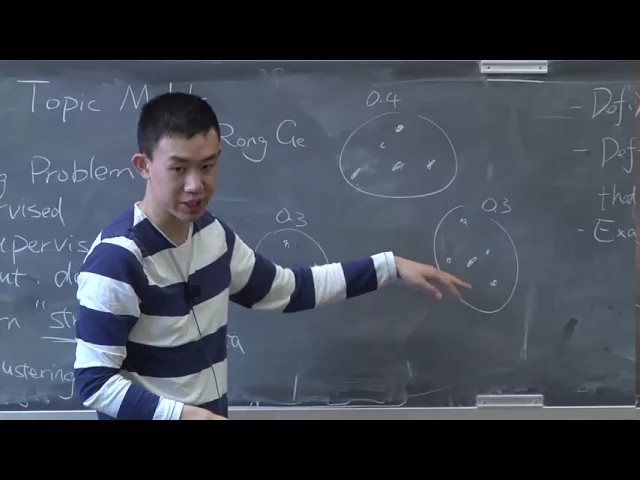
A guest lecture by Rong Ge (postdoc, Microsoft Research), standing in for Jelani Nelson, on learning topic models — a case study in applying theoretical-CS algorithm design to machine learning 0:00, 0:36.
The lecture builds one continuous chain: unsupervised learning is formalized as recovering the parameters of a probabilistic model; the standard tool (maximum likelihood) is NP-hard; four escape routes from NP-hardness are surveyed; topic models are defined via three simplifying assumptions; long documents reduce learning to the factorization M = A·W; that is non-negative matrix factorization, also NP-hard; and the separability / anchor-word assumption finally turns it into a convex-hull vertex-finding problem solvable with linear programs.
flowchart TD
    A["Unsupervised learning:<br/>recover structure without labels"] --> B["Formalize as: learn parameters<br/>of a probabilistic model"]
    B --> C["Maximum likelihood<br/>→ NP-hard (≥ k-means)"]
    C --> D["4 escapes: approximation /<br/>average case / natural assumptions / heuristics"]
    D --> E["Topic models:<br/>bag of words, topic = dist over words,<br/>doc = dist over topics"]
    E --> F["Long documents ⇒ M = A · W"]
    F --> G["Non-negative matrix factorization<br/>→ also NP-hard (Vavasis)"]
    G --> H["Natural assumption: separability<br/>(every topic has an anchor word)"]
    H --> I["Geometric problem:<br/>find vertices of a convex hull"]
    I --> J["Algorithm: per-point LP<br/>infeasible ⇒ vertex ⇒ anchor word"]
Topics
- Supervised vs. unsupervised learning
- Probabilistic models and the learning problem
- Maximum likelihood and its limits
- Four ways around NP-hardness
- Topic models: the goal and the three simplifying assumptions
- The topic matrix A and the document-generation recipe
- The long-document case and the identity M = A·W
- Non-negative matrix factorization (NMF)
- Separability and anchor words
- Reduction to a convex-hull problem, and the algorithm
Full source: transcript.md
Key takeaways
- Maximum likelihood for a mixture of Gaussians is at least as hard as k-means clustering, hence NP-hard, whereas for a single Gaussian it is easy and returns the sample mean
20:00,20:34. - Approximation algorithms are the wrong tool for maximum likelihood: a constant factor in log-probability space does not correspond to a constant factor in probability space, so an approximately-optimal
θcan assign vastly lower probability than the optimum24:06,24:29. - NP-hardness of maximum likelihood is a worst-case statement about arbitrary data points; the actual learning problem — data really drawn from
D(θ)— is average-case and therefore not covered by the hardness result21:03,21:46. - Letting a document be a distribution over topics (rather than pLSI's single topic) fits empirical data much better, which is why the field moved from pLSI to models like LDA
38:19,38:41. - For very long documents, learning a topic model is exactly non-negative matrix factorization: the observable document–word matrix satisfies
M = A·WwithAthe n × k topic matrix andWthe k × m topic-proportion matrix55:50,56:48. - Non-negativity, not normalization, is what makes NMF hard. Normalization is w.l.o.g.; dropping non-negativity reduces the problem to plain rank decomposition solvable by SVD — but SVD's factors cannot be read as probabilities. NMF itself is NP-hard (Vavasis)
59:09,59:33,59:57,1:00:19. - Separability (Donoho–Stodden) — every topic has an anchor word appearing in no other topic — reduces NMF to a purely geometric problem: after rescaling rows to sum to 1, every row of
Mis either a row ofWor lies in the convex hull of the rows ofW, so learning becomes finding the hull's vertices1:01:49,1:12:19,1:14:37. - Vertex detection is a single linear program per point:
vᵢis a vertex (anchor word) exactly when the LP expressing it as a convex combination of the other points is infeasible1:16:13,1:18:15,1:18:43. - Making it work on real data required two changes: test closeness to the convex hull instead of exact membership (estimates perturb points out of the low-dimensional subspace), and estimate pairwise word co-occurrence probabilities — which converge with enough documents — instead of
Mdirectly1:19:38,1:19:59,1:20:26. - The improved algorithm was implemented and run on a New York Times corpus, giving results comparable to the previous heuristic algorithms while being faster
1:20:53,1:21:24.