Harvard University · 1:25:41 · https://www.youtube.com/watch?v=vnS9_NKoEKI
Summary
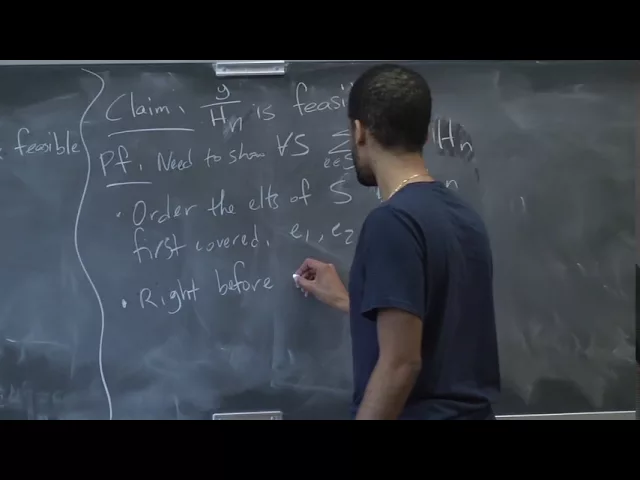
A Harvard graduate lecture on LP-based approximation algorithms, in three movements. It first completes the dual fitting analysis of greedy set cover (proving an H_K bound) and gives a clean primal-dual 2-approximation for vertex cover. It then turns to the limits of the LP framework, defining the integrality gap and exhibiting two concrete gap instances — the complete graph for vertex cover (gap → 2) and an F_2^Q construction for set cover (gap Θ(log n)) — plus Feige's NP-hardness barrier. Finally it defines PTAS / FPTAS / FPRAS and builds a full PTAS for knapsack, starting from a modified greedy 2-approximation.
Classification: educational video (university lecture, proof-driven, with live Q&A that corrects and refines several statements).
flowchart TD
    subgraph P1["Part 1 — LP-based approximation (what works)"]
        A["Set cover: dual fitting<br/>=> H_K approximation"]
        B["Vertex cover: primal-dual<br/>=> 2-approximation"]
    end
    subgraph P2["Part 2 — Integrality gaps (the limits)"]
        C["Vertex cover on K_n<br/>gap -> 2"]
        D["Set cover over F_2^Q<br/>gap = Theta(log n)"]
        E["Beyond LPs: Feige '98 + PCP"]
    end
    subgraph P3["Part 3 — Approximation schemes (1 + epsilon)"]
        F["PTAS / FPTAS / FPRAS definitions"]
        G["Knapsack: NP-hard, DPs are pseudo-polynomial"]
        H["Modified greedy => 2-approximation"]
        I["Guess big items + greedy<br/>=> PTAS"]
    end
    A --> C
    B --> C
    C --> E
    D --> E
    F --> G --> H --> I
Topics
- Lecture Overview and Set Cover Recap — agenda, the weighted set cover problem, the greedy price-ratio rule, and history (
0:00) - Dual Fitting Analysis of Greedy Set Cover — the primal/dual LPs, the price vector, and the
H_Kproof (4:23) - Vertex Cover: Greedy, LP Rounding, and a Primal-Dual 2-Approximation — three routes to the factor of 2 (
15:16) - Integrality Gaps: The Limit of an LP Relaxation — definition, two gap instances, and the hardness barrier beyond LPs (
26:37) - Approximation Schemes: PTAS, FPTAS, FPRAS — the three definitions and the
1/3failure-probability digression (45:32) - The Knapsack Problem and Its Exact Algorithms — fractional greedy, two DPs, and pseudo-polynomial time (
56:21) - A Modified Greedy 2-Approximation for Knapsack — why naive greedy fails, and Lemma 1 (
1:06:17) - A PTAS for Knapsack — guess the big items, greed the rest (
1:15:07)
Key takeaways
- Dual fitting proves greedy set cover is an
H_Kapproximation, not merelyH_n: charging each newly covered element a pricec_S / (new elements covered)gives a dualywithcost(x) = cost(y), andy / H_nis dual-feasible. The proof actually boundssum_{e in S} y_e <= c_S * H_KwhereK = |S|, so if all sets have size at mostK, greedy is alog Kapproximation (14:28,14:56). - Vertex cover admits a 2-approximation three ways, and the primal-dual route needs no rescaling at all: setting
x_u = x_v = 1andy_e = 1per covered edge keeps both solutions feasible automatically, with the primal rising by at most 2 per unit of dual — pure primal-dual, not dual fitting (24:28,25:44). LP rounding at threshold1/2gives the same factor and generalizes to aK-approximation for set cover when each element lies in at mostKsets (23:30). - Those factors are not artifacts of weak analysis — the LP relaxations themselves are that lossy. On
K_n, the LP puts1/2on every vertex for costn/2while the integer optimum isn - 1, a ratio tending to 2 (31:34,32:47). For set cover over the nonzero vectors ofF_2^Qwithn = 2^Q - 1, every element lies in exactly half the sets, sox_S = 2/mcosts only2fractionally, while a linear-algebra argument forces at leastQ ≈ log nsets integrally (41:21,44:55). - Beyond LP barriers, set cover is hard to approximate outright: Feige (1998) showed that beating
ln nwould let you solve SAT inn^{log log n}time, far below the exponential time of the best known SAT algorithms — a PCP-theorem result outside this course's machinery (47:37,47:55). - Knapsack's DPs run in
O(nW)andO(nV), which is pseudo-polynomial, not polynomial — the input encodesWinlog Wbits, so genuine polynomial time meanspoly(n, log W), which is why NP-hardness is not contradicted (1:01:48,1:03:44,1:04:12). - Naive ratio-greedy on knapsack can be off by a factor of
W(items(v=2, w=1)and(v=W, w=W): greedy gets2, OPT getsW), but returning the better of greedy and the single most valuable item is a 2-approximation, and the same Lemma 1 upgrades to a full PTAS in time~n^{1/epsilon + 1}by enumerating the<= 1/epsilonbig items and greeding the rest (1:07:53,1:09:29,1:20:44,1:24:20).