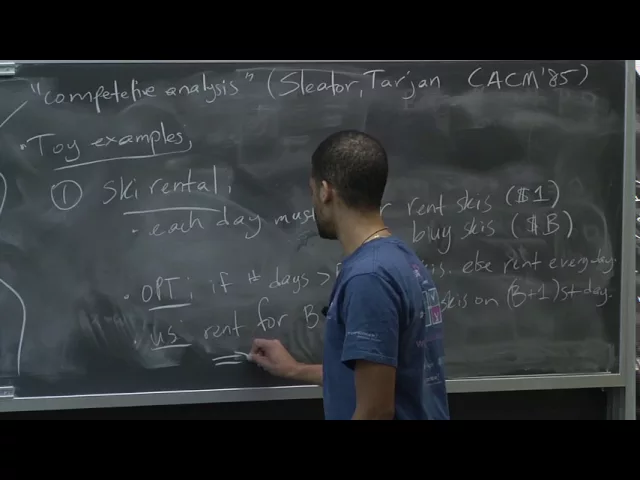
An introduction to online algorithms and competitive analysis: how to make irrevocable decisions without knowing the future, and how to prove you never spend much more than an omniscient optimum. After two warm-up examples (ski rental, searching a hallway), the lecture works through the two problems Sleator and Tarjan introduced competitive analysis for — list update, where move-to-front is proved dynamically optimal by a potential-function argument, and paging, where LRU and FIFO are k-competitive and no deterministic policy can do better. It closes with three ways around that lower bound — limited associativity, resource augmentation, and randomization — and begins the analysis of the randomized MARK algorithm, which reaches Θ(log k) against oblivious adversaries.
flowchart TD
    A["Competitive analysis<br/>(Sleator–Tarjan)"] --> B["Toy examples"]
    B --> B1["Ski rental — 2-competitive"]
    B --> B2["Free pizza — 9-competitive"]
    A --> C["List update"]
    C --> C1["MTF / transpose / frequency count"]
    C1 --> C2["Bentley–McGeoch:<br/>static optimality"]
    C2 --> C3["MTF is dynamically optimal<br/>(inversion potential)"]
    A --> D["Paging = list update with f(i)"]
    D --> D1["LRU / FIFO are k-competitive"]
    D1 --> D2["Lower bound: no deterministic<br/>algorithm beats k"]
    D2 --> E["Escapes"]
    E --> E1["Associativity"]
    E --> E2["Resource augmentation"]
    E --> E3["Randomization → MARK, 2·H_k"]
Topics
- Online algorithms and competitive analysis
- Toy example — ski rental
- Toy example — "free pizza" (searching a line)
- The list update problem and its heuristics
- Bentley–McGeoch: worst-case analysis and static optimality
- Move-to-front is dynamically optimal
- Paging as generalized list update
- LRU/FIFO are k-competitive — and the matching lower bound
- Circumventing the k lower bound
- The randomized marking algorithm
Key takeaways
- Competitive analysis replaces probabilistic modelling with a worst-case ratio:
Aisr-competitive ifcost_A(σ) ≤ r · cost_OPT(σ) + cfor every request sequence, where OPT knows the future — introduced by Sleator and Tarjan in the same year as the splay-tree paper (5:55,6:34). - Rent-then-buy is 2-competitive for ski rental: renting for
Bdays and buying on dayB+1costs at most2Bwhere OPT paysB(10:30); the exponential zig-zag search for the pizza room costs at most9Tagainst OPT'sT(17:04,17:42). - Move-to-front is dynamically optimal for list update:
cost_MTF(S) ≤ 2·cost_A(S) + paid − free − mfor every algorithmA, even one allowed paid exchanges and full knowledge of the future — proved with the number of inversions between the two lists as potential, giving amortized cost≤ 2i − 1per access (32:51,35:13,43:10). Empirically, Bentley–McGeoch found frequency count strong, MTF usually equal or better, and transpose bad (27:29). - Paging is tight at
k: LRU and FIFO arek-competitive via the phase argument on one-bit LRU (≤ kfaults per phase vs OPT's≥ 1), and no deterministic online algorithm can beatk— shown by an adversary overk+1pages that always requests what was just evicted while OPT, evicting farthest-in-future, faults once perkaccesses (51:42,52:47,55:25,1:05:45). Ratiokis not automatic: LFU is unboundedly bad (56:10). - Weakening the adversary buys big improvements: with resource augmentation LRU/FIFO become
k/(k − k′ + 1)-competitive — about 2-competitive when OPT has half the cache (1:09:41); and against an oblivious adversary the randomized MARK algorithm (evict a uniformly random unmarked page) achieves2·H_k ≈ 2 ln k, with a matchingΩ(log k)lower bound for any randomized scheme (1:15:40,1:17:44). Randomness is worthless against omniscient or adaptive adversaries (1:12:08,1:13:16).