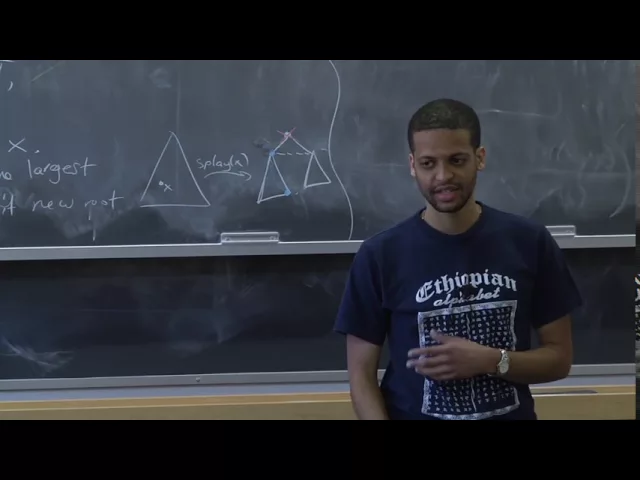
Harvard University · 1:26:46 · Watch on YouTube
Summary
A university lecture (Harvard COMPSCI 224, Advanced Algorithms) devoted entirely to splay trees — Sleator and Tarjan's self-adjusting binary search tree — as a second worked example of amortized analysis for a data structure. The first half is a survey: the BST model, how find/insert/delete are built on top of a splay subroutine, and the catalogue of properties splay trees are known (or conjectured) to satisfy — static optimality, working set, static and dynamic finger, the unresolved unified bound, and the 30-year-open dynamic optimality conjecture. The second half is the actual proof: a potential function Φ = Σ log s(x) built on arbitrary item weights, worked through case 2 of splay in full, yielding a master bound of O(1 + log(W/s(x))) per operation — from which uniform weights give O(log n) and weights 1/3^{L_i} give static optimality.
Classification: educational video (lecture in a graduate algorithms course), so the notes follow the lecture's own progression from definitions, to catalogued results, to the proof.
graph TD
    A["1. Splay trees & the BST model<br/>operations, rotation"] --> B["2. Known properties<br/>static optimality, working set,<br/>static & dynamic finger, unified bound"]
    B --> C["3. Dynamic optimality conjecture<br/>Tango & multi-splay trees"]
    C --> D["4. The splay operation<br/>three cases: zig / zig-zig / zig-zag"]
    D --> E["5. Amortized analysis<br/>potential Φ = Σ log s(x)<br/>master bound O(1 + log(W/s(x)))"]
    E --> F["6. Choosing weights<br/>w=1 ⇒ O(log n)<br/>w=1/3^L ⇒ static optimality"]
Topics
- Splay Trees and the BST Model — the dictionary problem, the BST model, rotations, and how
find/insert/deletereduce tosplay0:00 - The Known Properties of Splay Trees — static optimality, working set, static finger, dynamic finger, and the unified bound
10:35 - The Dynamic Optimality Conjecture — the open conjecture and how low the competitive ratio has been pushed
24:56 - The
splayOperation: Three Cases — why naive rotate-to-root fails, and the zig / zig-zig / zig-zag rules32:34 - Amortized Analysis via the Potential Function — weights, ranks,
Φ, and the full case-2 proof45:56 - Choosing Weights: O(log n) and Static Optimality — two instantiations of the master bound
1:14:36
Key takeaways
- The whole analysis reduces to one master inequality: the amortized cost of
splay(x)isO(1 + log(W / s(x))), whereWis the total item weight ands(x)the weight ofx's subtree. Every property of splay trees is then obtained by choosing the weight function — this is why the weights are left arbitrary throughout57:44,1:14:03,1:25:24. - Uniform weights
w(x) = 1immediately give O(log n) amortized per operation —W = n,s(x) ≥ 1— matching red-black/AVL trees with no balance information stored1:14:36. - Weights
w(i) = 1/3^{L_i}(from a fixed treeTplacingiat levelL_i) prove static optimality: splay trees service the sequence inO(m + n² + Σ m_i L_i)versusT'sO(m + Σ m_i L_i), from any arbitrary starting configuration. The proof needs only two facts —Φ ∈ [−n², 0]so it cannot swing by more thann², andW ≤ Σ_L (2/3)^Lis a convergent constant1:19:45,1:20:31,1:23:37,1:24:51. - The
−2in the potential drop is the crux of the case-2 proof, and it is what AM–GM buys. Boundingr'(z) ≤ r'(x)naively still givesO(r'(x) − r(x))but loses the−2that cancels the two rotations' actual cost; the AM–GM step plus the structural facts(x) + s'(z) ≤ s'(x)yieldsr'(z) ≤ 2r'(x) − r(x) − 21:07:53,1:09:12,1:10:30. - Rotating
xto the root naively is provably useless: on the path6→5→4→3→2→1, repeatedrotate(6)leaves the depth atn. The zig-zig rule (rotate the parent first) is exactly the fix — splaying a path leaf roughly halves its depth33:42,34:04,45:13. - Dynamic optimality remains open after ~30 years. Any balanced BST is O(log n)-competitive against offline OPT; Tango trees (Demaine–Harmon–Iacono–Pătraşcu 2004) push this to O(log log n), and multi-splay trees (Wang–Derryberry–Sleator, SODA 2006) match O(log log n) while also giving O(log n) amortized and O(log² n) worst case. Whether splay trees themselves are O(1)-competitive is unknown
27:23,30:26,31:11,31:59. - The unified bound is open even for the whole BST model, not just splay trees. Iacono (2001) achieves it with a non-BST structure; the best BST-model result is Derryberry–Sleator (2009) at
O(m log log n + unified bound), where the goal ism23:16,23:44,24:28. - Splay trees are not just a theory artifact: they won the Paris Kanellakis Theory and Practice Award in 1999 for being one of the most widely used data structures invented in the preceding 20 years
2:22,2:52.