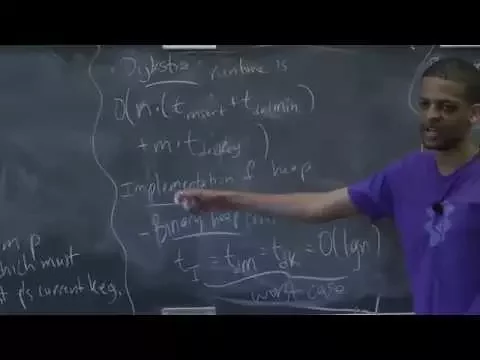
Harvard University · 1:23:46 · Watch on YouTube
Summary
This lecture leaves the word RAM model behind and opens the course's unit on amortized analysis, introducing the potential function method and then applying it to priority queues. It builds binomial heaps as a warm-up — a forest of one tree per rank behaving like a binary counter — proves constant amortized insertion for them, and then derives Fibonacci heaps by making binomial heaps as lazy as possible: consolidation is deferred entirely to delete-min, and decrease-key just cuts a subtree loose. The one repair that makes laziness safe is the mark bit and cascading cuts, which forces rank-k trees to have at least F_{k+2} nodes and gives the O(1) / O(1) / O(log n) amortized bounds for insert, decrease-key and delete-min. The lecture closes with an extended Q&A on how to think about potential functions and a preview of splay trees and static optimality.
Classification: educational video (university lecture, blackboard-based, with live class Q&A).
flowchart TD
    A["Amortized analysis<br/>+ potential function method"] --> B["Heap ADT:<br/>insert / delete-min / decrease-key"]
    B --> C["Motivation: Dijkstra<br/>n(t_ins + t_del) + m·t_dec"]
    C --> D["Binomial heaps<br/>forest, one tree per rank, binary counter"]
    D --> E["Φ = trees ⟹ insert O(1) amortized"]
    E --> F["Be lazy:<br/>defer consolidation to delete-min<br/>cut subtrees on decrease-key"]
    F --> G["Problem: rank no longer<br/>certifies size"]
    G --> H["Fix: mark bits +<br/>cascading cuts"]
    H --> I["rank-k tree ≥ F_{k+2} nodes<br/>⟹ max rank = O(log n)"]
    I --> J["Φ = trees + 2·marks ⟹<br/>O(1), O(1), O(log n) amortized"]
    J --> K["Next lecture:<br/>splay trees, static optimality"]
Topics
- Course logistics and lecture roadmap —
0:00 - Amortized analysis and the potential function method —
2:03 - The heap ADT and what Dijkstra needs from it —
10:47 - Heap implementations and the landscape of known bounds —
14:42 - Binomial heaps: structure and operations —
27:56 - Amortized analysis of binomial heaps —
39:26 - Fibonacci heaps: designing by being lazy —
44:17 - Rank versus size: where the Fibonacci numbers come from —
54:29 - Amortized analysis of Fibonacci heaps —
59:50 - Q&A: what potential functions are actually doing —
1:12:58 - Preview: splay trees and static optimality —
1:20:16
Key takeaways
- The potential function method is sound with only two requirements —
Φ(∅) = 0andΦ ≥ 0— because summingt_i + ΔΦ_itelescopes toΣ t_i + Φ(S_k) ≥ Σ t_i; a per-operation amortized bound is then the worst case ofactual + ΔΦover that operation type9:34,10:27,1:19:19. - With
Φ = number of trees, binomial heap insertion isO(1)amortized despiteO(log n)worst case: the actual costt − t' + 1cancels exactly againstΔΦ = t' − t, leaving 142:15,43:23. - Pure laziness breaks the structure: unrestricted cutting on decrease-key can leave a rank-
ktree holding onlyk+1items, destroying the "rank certifies size" argument that bounds delete-min51:19,52:02. - The mark-bit rule (cut a node once it loses its second child) restores the bound: the smallest rank-
ktrees have sizes 1, 2, 3, 5, 8, i.e. at leastF_{k+2}, which grows exponentially and forces max rank= O(log n)52:27,58:41,59:23,1:07:49. - With
Φ = trees(H) + 2·marks(H), Fibonacci heaps achieve insertO(1), decrease-keyO(1), delete-minO(log n)amortized —ccascading cuts costO(c)but change potential by+c − 2c, so the cost collapses to a constant; delete-min's worst case, however, is still linear1:00:59,1:10:26,1:10:58,1:12:58. - Constant delete-min is impossible for these comparison-based structures (heapsort would sort in
O(n)), but word RAM escapes it: the better of fusion trees and van Emde Boas givesO(√log n)per operation22:14,24:24. - Later work matched Fibonacci heap bounds in weaker models — Brodal (SODA '96) made them worst case, and Brodal–Lagogiannis–Tarjan (STOC 2012) achieved them on a pure pointer machine — motivated by Fibonacci heaps' large constants making them impractical
20:28,23:14,27:20.