Harvard University · 1:21:37 · Watch on YouTube
Summary
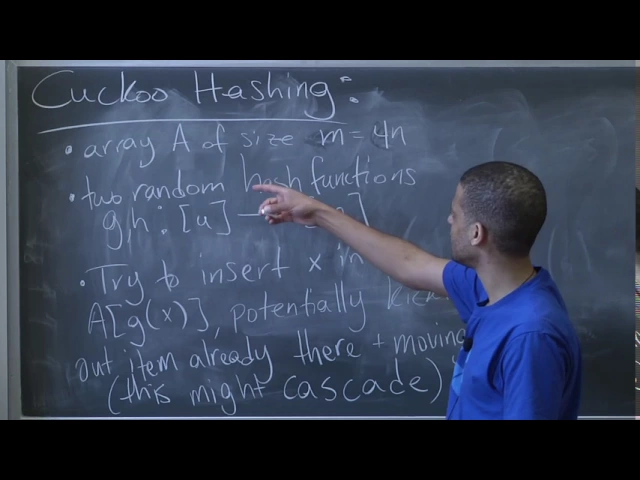
The lecture that closes out hashing in COMPSCI 224. The first half completes the expected-O(1) insertion proof for cuckoo hashing: it recalls the scheme (two hash functions, unconditional placement, cascading evictions, rebuild after C log n steps), models an insertion as a walk in the cuckoo graph, splits it into three cases (path, single cycle, double cycle), and bounds each by fixing a configuration, computing its probability, and union-bounding — the array size m = 4n being chosen precisely to make the resulting series geometric. The second half turns to load balancing and the power of two choices: probing two random bins and inserting into the less loaded drops the maximum load from Θ(log n / log log n) to ln ln n / ln 2 + Θ(1), an exponential improvement, while going from two to d choices only changes the base of the log. The lecturer walks through the doubly-exponential "squaring" intuition behind log log n, then attempts the rigorous Chernoff-based version and openly leaves two gaps for the written notes — an off-by-one in the double-cycle count and a conditioning-dependency issue in the main claim — before previewing amortized analysis and Fibonacci heaps.
flowchart TD
    A["Cuckoo hashing: prove E[insert] = O(1)"] --> B["Cuckoo graph: m vertices, n edges"]
    B --> C["Case 1: path — E[P_k] ≤ 1/2^k"]
    B --> D["Case 2: one cycle — E[C_k] ≤ 1/2^(k/3)"]
    B --> E["Case 3: two cycles — Pr[D] = 1/poly(n) → rebuild"]
    C --> F["Geometric sums = O(1) ⇒ E[insert] = O(1)"]
    D --> F
    E --> F
    F --> G["Load balancing: power of two choices"]
    G --> H["Max load: ln ln n / ln 2 + Θ(1)"]
    G --> I["Power of d: only changes the log base"]
    G --> J["Vöcking: d groups + leftmost tie-break → ln ln n / d"]
    H --> K["Intuition: B_(i+1)/n ≤ (B_i/n)² squaring"]
    K --> L["Rigorous: α_i sequence + Chernoff + union bound"]
    L --> M["Next: amortized analysis, Fibonacci heaps"]
Topics
- Lecture Plan and Cuckoo Hashing Recap — the scheme, the eviction cascade, and the
C log nrebuild rule. - The Cuckoo Graph and the Three Insertion Cases — path, single cycle, double cycle, and the runtime recurrence they feed.
- Bounding Paths and Single Cycles — fix-a-configuration + union bound, and why
m = 4n. - Bounding Double Cycles and Closing the Proof — the only dangerous case, the acknowledged off-by-one, and the free bound on the cutoff term.
- The Power of Two Choices — Azar–Broder–Karlin–Upfal, power of
d, and Vöcking's asymmetric variant. - Intuition: Where log log n Comes From — the non-rigorous squaring argument, in full.
- Making the Analysis Rigorous — the
α_isequence, Chernoff, and the dependency gap left unclosed. - Preview: Amortized Analysis and Fibonacci Heaps — the heap interface and the Dijkstra payoff.
Key takeaways
- Cuckoo hashing inserts in expected
O(1)time, provided a run of more thanC log nevictions triggers a full rebuild with fresh hash functions; the proof works by making both rebuild-triggering probabilities1/poly(n)so theirn · E[T]cost vanishes (3:17,14:29,42:00). - A cycle in the cuckoo graph is harmless; two cycles are fatal. A single cycle unwinds and the insertion still terminates via
h(x), but a second cycle loops forever — it is caught only by the step cutoff (8:25,8:46,9:28). E[P_k] ≤ 1/2^kfor eviction paths, and the constantm = 4nis chosen exactly to produce that base-2 geometric decay from the2^k · (n/m)^kbound (22:53,23:13).- Single-cycle configurations need no new computation: split the edges into three groups, note one group has
≥ k/3edges, and reuse the path bound to get roughly1/2^{k/3}(24:28,25:10). - Double-cycle probability is
k³/2^kover a polynomial inn, summing to1/poly(n); the extrak³factor counts where each cycle starts and how long the first one is (36:44,39:11,41:04). - Two live errors were acknowledged, not papered over: an off-by-one in the double-cycle vertex/item count (his guess: a length-
ktour carriesk − 2items, notk, since items repeat), and a conditioning dependency that breaks the clean(B_i/n)²per-item probability once you condition onE_i— both deferred to the written notes (39:55,42:59,1:13:22). nballs intonbins with one random choice gives a max load ofΘ(log n / log log n); a 2-wise independent hash function already givesO(1)expected query time with that same worst case w.h.p. (46:26,46:53).- Two choices drop the max load to
ln ln n / ln 2 + Θ(1), tightly concentrated within ±O(1) (Azar, Broder, Karlin, Upfal, SICOMP '99) — an exponential improvement from probing one extra bin (47:27,49:39,50:23). - Going from 2 to
dchoices buys almost nothing: the bound becomesln ln n / ln d, only a change of log base, i.e. a constant factor — while query cost grows by a factor ofd(50:52,51:17,51:57). - Vöcking's variant beats plain power-of-
d: partition bins intodequal groups, probe one per group, and break ties by taking the leftmost bin — max loadln ln n / d, effectively moving the log base fromdtoe^d. Less randomness, better result (53:25,54:44,55:10). - The
log log ncomes from a squaring recurrence: since both bins must be full for an item to reach heighti+1and the two hash functions are independent,B_{i+1}/n ≤ (B_i/n)², so once the fraction is below1/2it drops to(1/2)^{2^j}and hits zero bins afterlog log nlevels (1:00:41,1:02:19,1:03:33). - The rigorous version replaces the random
B_iwith a deterministicα_i(α_6 = n/2e,α_{i+1} = e·α_i²/n), starting at level 6 becausePr[E_6] = 1holds trivially and Chernoff tails there are small enough to survive a union bound over all levels (1:05:36,1:06:32,1:08:41). - Fibonacci heaps give
O(1)insert and decrease-key withO(log n)delete-min, taking Dijkstra fromm log n(binary heaps) tom + n log n, and speeding up all-pairs shortest paths run asnDijkstras (1:20:28,1:20:45).