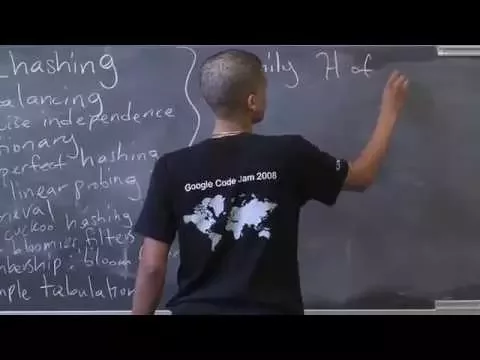
Harvard University · 1:28:46 · https://www.youtube.com/watch?v=WqBc0ZCU4Uw
Summary
A Harvard graduate lecture on hashing in the word RAM model. It starts with hashing as load balancing — the balls-and-bins process — proving that n jobs hashed to n machines leave no machine with more than O(log n / log log n) jobs, first via the Chernoff bound and then via a much simpler union-bound argument. That second proof motivates the lecture's central concept, k-wise independence: because the argument only ever inspects k items at a time, an expensive truly-random hash function (u log u bits) can be replaced by a degree-k-1 polynomial family (k log u bits). The lecture then applies hashing to the dictionary problem — chaining with a 2-wise family for expected O(1) operations — before turning to linear probing, its cache-friendliness, its historical results, and the beginning of a proof that 7-wise independence gives constant expected query time via full intervals and the moment method.
Topics
- Course roadmap and what hashing is — the day's agenda, the formal
H : U → Msetup, and the notation used throughout. - Load balancing: jobs, machines and balls-in-bins — the Chernoff bound, its Markov-based proof sketch, and two proofs of the max-load result.
- k-wise independence — definitions, polynomial families, storage savings, the
mod p mod mwraparound bias. - The dictionary problem and hashing with chaining —
update/query, chaining with a 2-wise family, expectedO(1). - Linear probing: the scheme, why it wins in practice, and known results — prefetching, Knuth 1963, the 2007/09 5-wise breakthrough, Pătraşcu–Thorup 2010.
- Analysing linear probing: full intervals and the moment method — the full-interval lemma, the
O(1/K³)target, the 6th-moment argument.
flowchart TD
    H["Hashing in the word RAM"] --> LB["Load balancing<br/>(balls and bins)"]
    LB --> CH["Chernoff bound<br/>needs full independence"]
    LB --> UB["Union-bound proof<br/>touches only k items at a time"]
    UB --> KW["k-wise independence<br/>polynomial families, cheap storage"]
    H --> DICT["Dictionary problem"]
    DICT --> CHAIN["Chaining<br/>2-wise ⇒ expected O(1)"]
    DICT --> LP["Linear probing<br/>cache-friendly"]
    KW --> LP
    LP --> AN["Full-interval analysis<br/>7-wise ⇒ O(1) via moment method"]
    CH -.->|no full independence available| AN
Key takeaways
- Hashing
njobs ontonmachines keeps the maximum load atO(log n / log log n)with probability1 - 1/poly(n); the same bound comes out of both the Chernoff bound and a plain union bound overk-subsets10:36,23:16. - Chernoff is overkill for that result: the union-bound proof only needs
E[Π Xi] = Π E[Xi]over sets of sizek, solog n / log log n-wise independence suffices instead of full independence19:10,25:56,34:44. - Storing a truly random hash function costs
u·log m ≈ u log ubits, while a degree-k-1polynomial family costs onlyk·log u—O(log u)for constantk32:26,33:39. - Degree-
k-1polynomials mod a primepare k-wise independent by polynomial interpolation (p^kcoefficient vectors biject withp^koutput tuples), and are not fully independent for the same reason: anykevaluations determine all the rest38:19,50:40. - Reducing
mod p mod mwithm < pbreaks exact uniformity — worst casep = m+1, where one residue is twice as likely — but no outcome exceeds2/m, so probabilities are bounded by(2/m)^kand the load-balancing conclusion is unchanged42:56,44:11,46:06. - Chaining with a 2-wise independent family solves the dynamic dictionary in expected
O(1)per operation as long asm ≥ n54:22,57:46. - Linear probing's edge is hardware, not asymptotics: prefetching makes its sequential probe runs far faster on real machines than chaining's pointer chases
59:36,1:00:51. - Independence thresholds for linear probing are sharp: Knuth (1963) got
O(1/ε²)with a truly randomhandm = (1+ε)n; the 2007/09 breakthrough paper showed 5-wise independence already givesO(1); Pătraşcu–Thorup (ICALP 2010) exhibited a 4-wise family forcingΘ(log n)1:04:36,1:05:55,1:06:40. - The 4-wise counterexample is existential, not universal — a merely 3-wise family with extra structure still performs well for linear probing, promised for the next lecture
1:07:03,1:07:24. - Expected linear-probing query time reduces to
Σ_K K·Pr[interval of length K is full], so provingPr[full] = O(1/K³)makes the sum converge; the odd-looking independence constants come from conditioning on one element (5 = 1 + 4, 7 = 1 + 6)1:08:11,1:20:49,1:21:29. - Since Chernoff is unavailable without full independence, the
O(1/K³)bound is obtained by the moment method — raise the deviation to the 6th power and apply Markov — which works precisely because concentrated random variables survive high powers1:25:47,1:26:40,1:27:39. - The full-interval lemma needed an in-class correction: the surrounding full interval has length at least
K, not exactlyK, since the displacing chain can start far earlier1:16:34,1:17:13.