Harvard University · 1:25:39 · Watch on YouTube
Summary
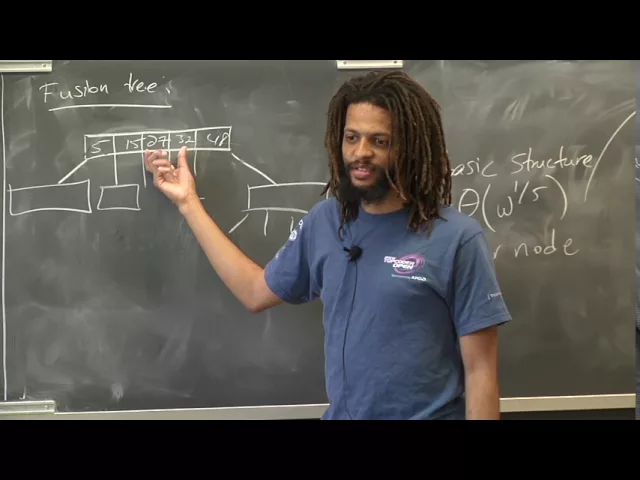
A full lecture on fusion trees (Fredman–Willard), the Word-RAM data structure that answers static predecessor queries in O(log_w n) time. After a short erratum about the van Emde Boas space argument from lecture 1, the lecture builds a Θ(w^(1/5))-ary search tree whose height is O(log_w n), then spends the rest of the hour solving the one hard problem this creates: a node holding w^(1/5) full-word keys occupies w^(6/5) bits, so it cannot even fit in a machine word — yet it must be searched in constant time.
The solution is assembled from four bit-level ingredients: sketching (project keys onto their branch bits), multiplication as an approximate bit-gathering instruction, word-level parallelism (compare the query against all k keys with one subtraction and one multiplication), and a constant-time most-significant-bit routine. Along the way the lecture handles the subtle case where the query is not one of the stored keys, and proves the multiplier lemma that makes approximate sketching work.
flowchart TD
    A["Fusion tree: k = Θ(w^(1/5))-ary tree<br/>height O(log_w n)"] --> B["Problem: node = w^(6/5) bits<br/>must be searched in O(1)"]
    B --> C["Sketching: keep only branch bits<br/>k·r = O(w^(2/5)) bits"]
    B --> D["Word-level parallelism:<br/>compare vs all k keys at once"]
    C --> E["Approximate sketch via multiplication<br/>→ r^4 = w^(4/5) bits"]
    E --> F["Multiplier lemma: distinct sums,<br/>increasing diagonal, O(r^4) spread"]
    D --> G["Subtraction + count-by-multiply"]
    C --> H["Query not in the set?<br/>surrogate key e, found via MSB(x XOR q)"]
    H --> I["MSB in O(1):<br/>√w chunks + perfect sketch + 2 parallel comparisons"]
    G --> I
    F --> J["O(1) per node ⇒ O(log_w n) query"]
    G --> J
    I --> J
Topics
- Correction to the van Emde Boas space argument —
0:00 - Fusion trees: problem statement and known bounds —
1:35 - The k-ary tree structure and the constant-time-per-node constraint —
4:14 - The Word-RAM toolkit —
9:52 - Sketching: branch bits —
13:52 - When the query's sketch lies about where it belongs —
21:14 - Approximate sketching via multiplication —
37:37 - Proof of the multiplier lemma —
56:05 - Node layout and parallel comparison —
1:03:39 - Constant-time most significant bit —
1:12:44
Full transcript.
Key takeaways
- CLRS Exercise 20-1(f)'s intended solution is wrong. Replacing vEB arrays with hash tables does not actually give
O(n)space — it is slightly worse, and this is not just a gap in the argument.O(n)is still reachable (assigned as a P-set problem), and y-fast tries as presented already achieve it via indirection (0:39,0:56,1:12). - Fusion trees achieve
O(log_w n)static predecessor queries withk = Θ(w^(1/5))keys per node; the heightlog_{w^(1/5)} nreduces exactly tolog_w n. Andersson–Thorup later added deterministiclog_w n + log log nupdates, Raman expectedlog_w nupdates (2:35,6:39,7:10). - Only
O(1)time per node is affordable. Scanning a node costsk·log_k n(worse thanlog n); binary search inside a node costslog k · log_k n = log n, cancelling the gain entirely — which is why the whole lecture is spent on constant-time node search (7:37,7:53). - Sketching shrinks a node from
w^(6/5)bits toO(w^(2/5)). Projecting keys onto theirr < kbranch bits preserves their relative order, and all k sketches then fit in a single word (18:23,20:03). - Multiplication substitutes for the missing "gather bits" instruction. With a multiplier
msatisfying the lemma (allr²sumsb_i + m_jdistinct → no carries; diagonal sums increasing; spreadO(r^4)), a sketch costs exactly four word operations — mask, multiply, mask, shift — and works on an online query, compressing the important bits from a width ofwdown tor^4 = w^(4/5)(48:09,49:41,53:51,1:03:39). - The lemma's multiplier exists by a counting argument: at most
t·r² < r³values are forbidden at each inductive step whiler³residues are available, so a validm'_talways exists; addingi·r³then separates the sums into distinct blocks (58:39,1:01:01). - A sketch alone can point to the wrong subtree. Shown concretely with
q = 0101against keys0000, 0010, 1100, 1111:sketch(q) = 00places it at the bottom althoughqreally lies between0010and1100. The fix is a surrogatee = y·0·11…1ory·1·00…0, whereyis located by taking the more significant ofMSB(x_i XOR q)andMSB(x_{i+1} XOR q)(22:02,25:52,29:56,34:54). - Parallel comparison beats all k keys at once with one subtraction plus one multiplication. Sentinel 1 bits stop carries from crossing blocks; the resulting leading bits are monotone, so the position of the first 1 is recovered by counting 1s — a multiply that sums all copies into a single
log k-wide field. MSB is deliberately avoided here to prevent circularity, since MSB is itself built from this trick (1:06:04,1:07:46,1:09:21,1:12:15). - MSB drops from
O(w)(loop) orO(log w)(binary search) toO(1)by splitting into√wchunks of√wbits, marking nonempty chunks with anF − xborrow trick, compacting the summary with a perfect sketch (possible because the bit positionsi√w + √w − 1are regular), then running two parallel comparisons — one to find the chunk, one to find the bit inside it (12:02,12:19,1:18:29,1:21:30,1:24:26). - The static structure cannot be used for sorting — preprocessing is polynomial and exceeds sorting time — but the dynamic Andersson–Thorup and Raman variants can. In practice the constant-time MSB is asymptotic only: on 64-bit words
log log w ≈ 6, and the constant-time method uses more than 6 operations (3:48,13:09).